
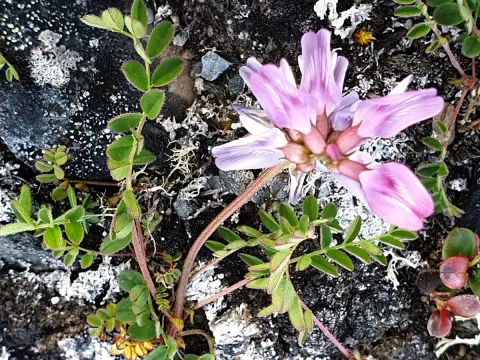
Norwegian milkvetch
Astragalus norvegicus
Norwegian milkvetch is a perennial legume, therefore the optimal sowing period is early spring, as soon as the soil warms up to 5-8 degrees Celsius.
What the section contains
Norwegian milkvetch
Late autumn sowing is also possible in regions with mild winters, which facilitates natural seed stratification, positively affecting spring field germination.
Seed preparation is a critical factor, as milkvetch seeds have a dense coat; scarification is recommended to increase germination energy and uniformity.
The sowing depth is 1-2 centimeters depending on the soil texture, ensuring a firm contact between the seed and soil moisture for successful emergence.
Sowing is carried out in rows with 15-20 centimeter spacing using standard grain-seeding equipment adapted for small seeds.
The crop has high water requirements during its first year of establishment when the root system is developing to penetrate into deeper soil horizons.
Norwegian milkvetch prefers well-drained, fertile loamy or sandy loam soils with a neutral or slightly alkaline pH level.
The plant exhibits high winter hardiness and is capable of withstanding harsh northern climates, making it a promising crop for short growing seasons.
While tolerant of low temperatures, it is sensitive to waterlogging; therefore, planting in fields with high groundwater levels should be avoided.
Good light exposure is necessary for vigorous growth, so weed control is essential, especially during the initial stages of vegetative development.
The primary pests for young milkvetch stands are weevils, which can damage the growing point and reduce the overall density of the crop canopy.
Under conditions of high humidity and poor air circulation, the crop can be susceptible to fungal diseases such as powdery mildew or various rust fungi.
Larvae of certain bug species can cause damage to reproductive structures, negatively affecting seed yield in dedicated seed production fields.
Effective pest management relies on agronomic practices, including strict crop rotation and timely suppression of competing weed populations.
If chemical pesticides are required, it is crucial to adhere to strict pre-harvest intervals, especially if the forage is intended for livestock feed.