
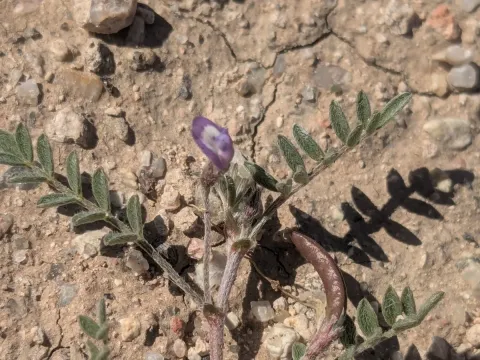
Nuttall's milkvetch
Astragalus nuttallianus
Nuttall's milkvetch (Astragalus nuttallianus) is an annual legume native to North America, known for its ability to thrive in harsh environments. It is increasingly recognized for its role in pasture management and land restoration projects.
What the section contains
Nuttall's milkvetch
The optimal sowing time is during the early spring or late autumn, depending on the climatic zone. The seeds require a well-prepared seedbed, firm enough to ensure consistent moisture contact, yet loose enough for root development.
Sowing depth should be kept shallow, generally around 1 to 2 centimeters. Because the seeds are small, precision drilling or broadcasting followed by light rolling is the most effective method for establishing a uniform stand.
Nuttall's milkvetch exhibits a natural ability to reseed itself if the conditions are favorable, making it a sustainable choice for certain low-input forage systems. This characteristic reduces the need for frequent re-seeding.
During the establishment phase, ensuring the field is free of competitive weeds is crucial. Once established, the crop becomes more resilient, but initial weed control through mechanical or cultural methods is vital for success.
This species is well-adapted to arid and semi-arid conditions, preferring well-drained sandy or loamy soils. It displays remarkable drought tolerance, allowing it to maintain growth during periods of limited precipitation.
Nuttall's milkvetch thrives in alkaline to neutral soil pH levels. It is capable of growing in soils with low organic matter, thanks to its nitrogen-fixing symbiosis with rhizobia bacteria, which significantly boosts soil fertility.
Light requirements for this crop are high; it performs best in full sunlight. Shaded areas lead to spindly growth and reduced overall biomass production, which is undesirable for forage or cover crop purposes.
Temperature range tolerance is broad, making it suitable for regions with hot, dry summers and mild winters. It is highly efficient in managing water use, which is a major advantage in water-scarce agricultural regions.
Adequate soil aeration is essential for root health. Waterlogged soils should be strictly avoided, as stagnant water is the primary cause of root-related failures in Astragalus species.
Fungal pathogens, particularly those causing root rots, represent the most significant threat to Nuttall's milkvetch. These diseases are most prevalent in seasons with unusually high humidity or poor field drainage.
Insect pests, including various aphids and bean-specialized beetles, can cause localized damage to foliage and developing seed pods. Monitoring programs are recommended to determine if chemical or biological intervention is necessary.
Weed competition is a critical challenge during the early seedling stage. If weeds outgrow the legume, they can effectively suppress it, leading to sparse stands and poor biomass yield for the season.
Proper crop rotation is necessary to break the life cycle of soil-borne pathogens. Integrating Nuttall's milkvetch into a diversified rotation strategy prevents the build-up of specific legume-targeting diseases.
Although it serves as forage, caution is advised regarding livestock consumption in certain regions. Some species of the Astragalus genus can accumulate selenium; therefore, testing for toxicity is standard agricultural practice.