
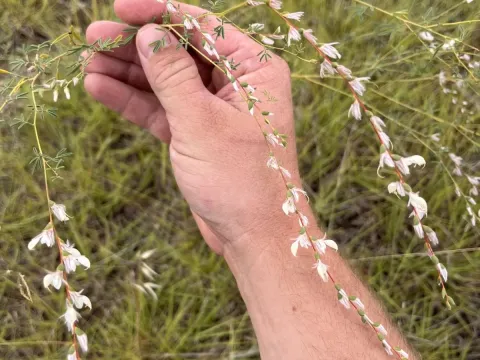
Nine-anther prairie clover
Dalea enneandra
Sowing of Dalea enneandra is best performed in early spring once soil temperatures are consistently above the threshold required for germination to ensure healthy establishment.
What the section contains
Nine-anther prairie clover
Seeds of this species are known for their hard seed coats, making scarification or cold stratification necessary to improve uniformity and germination rates in field conditions.
The optimal seeding depth is shallow, typically around 1 to 2 centimeters, to balance the need for moisture with the seedling's capacity to emerge through the soil surface.
Seed density should be calculated based on the intended use of the stand, whether it is for soil stabilization, forage production, or restoration of native prairie landscapes.
Initial weed management is crucial during the first season of growth, as the plants dedicate significant resources to developing their deep root systems rather than above-ground biomass.
Dalea enneandra, a member of the Fabaceae family, is a perennial legume highly valued for its exceptional performance in arid and semi-arid environmental conditions.
The plant thrives in full sun exposure and is remarkably adapted to sandy, rocky, or gravelly soils, making it an excellent choice for stabilizing erodible landscapes.
It demonstrates strong drought tolerance, aided by a profound taproot system that reaches moisture stored deep within the soil profile, ensuring survival during hot, dry spells.
Chemical soil composition is rarely a limiting factor, as the plant shows excellent performance in nutrient-poor and alkaline substrates, typical of its native prairie habitat.
Cold hardiness is a defining feature of the species, allowing it to withstand harsh winters in continental climate zones where other forage legumes might fail.
As a forage crop, Dalea enneandra provides high-quality grazing material, particularly during mid-to-late summer when traditional grasses may enter dormancy and lose nutritional density.
The yield potential is significantly enhanced through nitrogen fixation, which benefits not only the clover itself but also surrounding plant communities in mixed-stand systems.
Livestock producers find the clover to be a palatable and protein-rich option, which supports improved weight gain and overall health in grazing animals.
While the annual yield might be lower than highly managed intensive crops, the sustainability and low input requirements make it a cost-effective choice for extensive agriculture.
Biomass production peaks during the flowering stage, providing the optimal window for harvesting to maximize the nutritional output per unit of land.
The nine-anther prairie clover is naturally resilient, displaying a high degree of resistance to many of the common fungal and bacterial diseases that plague standard forage legumes.
The primary threats to stand health include excessive water accumulation in the soil, which can lead to root pathogens if site drainage is poorly managed or overlooked.
Insects and pests generally do not cause economic damage to the stands, as the plant has evolved to defend itself against the stressors found in its native ecosystem.
Proper field maintenance, such as ensuring sufficient spatial density between rows, helps prevent the onset of localized environmental stresses during periods of high humidity.
Management practices focused on promoting plant vigor are usually sufficient to mitigate potential damage from environmental stressors or occasional pest pressures.
Harvesting for forage is recommended during the full bloom phase, which represents the point of maximum nutritional value regarding protein and mineral content for livestock.
The mowing technique should prioritize a clean cut at an appropriate height to prevent injury to the basal buds, ensuring the plant's ability to regenerate and produce a second cut if moisture allows.
For seed production, harvesting must be timed carefully when the seed pods have dried significantly but before they naturally dehisce and release their contents.
Post-harvest handling requires gentle drying techniques to minimize leaf shatter, as the leaves contain the highest concentration of digestible protein in the plant.
Storage of the harvested seeds should occur in well-ventilated, dry conditions to maintain seed viability and prevent the buildup of moisture that leads to spoilage.