
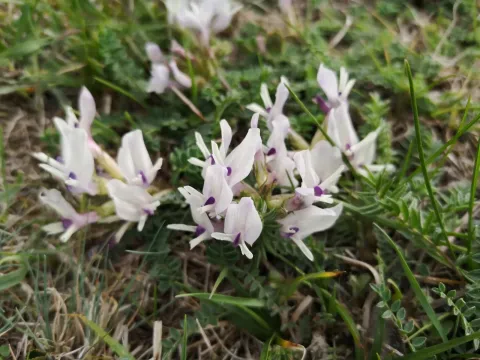
Kazbegi milkvetch
Astragalus kazbeki
Kazbegi milkvetch (Astragalus kazbeki) is a perennial herbaceous plant belonging to the legume family (Fabaceae). In its natural habitat, the species propagates mainly through seeds.
What the section contains
Kazbegi milkvetch
Sowing should be performed in late autumn or early spring, strictly following a seed stratification process. Because the seeds have hard coats, scarification is essential to ensure uniform germination.
Seeds should be planted at a depth of 1–2 cm. It is critical to maintain consistent soil moisture during the germination stage, as the seedlings are sensitive to dehydration.
The plant demonstrates slow growth during its first year, focusing on root system establishment. Keeping the area free of weeds is vital for the survival of young plants.
For agricultural purposes, wide-row sowing with a spacing of up to 45 cm is recommended to facilitate proper maintenance and mechanical weed control.
As a high-mountain endemic of the Caucasus, this species requires specific environmental conditions to thrive and reach its full potential.
It prefers well-drained, sandy-loam or rocky soils with moderate humus content and a neutral to slightly alkaline pH level.
The plant is highly frost-resistant, having adapted to the harsh temperature fluctuations characteristic of alpine and subalpine environments.
High light intensity is crucial for the photosynthesis process; therefore, fields must be located in open areas with no shading from trees or shrubs.
Waterlogging is extremely detrimental to the root system, often leading to rapid decay and plant death; thus, good field drainage is a primary necessity.
The primary threats to Astragalus kazbeki in cultivation include root rots caused by poor soil aeration or excess moisture levels.
During periods of high humidity, powdery mildew may affect the foliage, requiring immediate prophylactic monitoring and application of fungicides.
Weevils are the most significant pests, specifically damaging reproductive organs and significantly reducing the yield of viable seeds.
Root-feeding pests that target nitrogen-fixing nodules can indirectly weaken the plant by hindering its ability to fix atmospheric nitrogen.
Integrated pest management, including crop rotation and removal of plant residues, is essential to maintain a healthy plantation.
Green biomass harvesting is ideally performed during the peak flowering stage, which ensures the highest nutritional value and biological activity.
Seed collection should take place as soon as the pods change color but before they shatter, preventing excessive seed loss in the field.
If the harvest is intended for medicinal or pharmacological use, rapid drying in shaded, well-ventilated areas is necessary to preserve the plant's quality.
Proper drying prevents mold development, which is critical for ensuring the longevity of the harvested produce.
Systematic harvesting helps encourage vegetative growth for the following season, maintaining the overall productivity of the perennial field.