
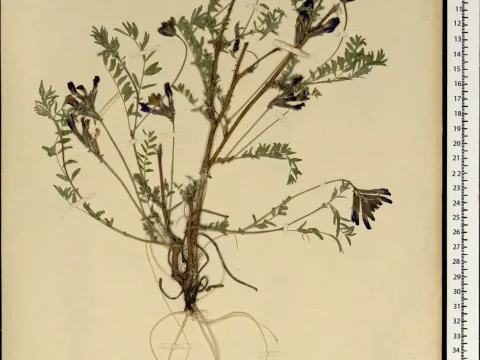
Shrubby milkvetch
Astragalus fruticosus
Shrubby milkvetch (Astragalus fruticosus) is a perennial semi-shrub belonging to the Fabaceae family. It is recognized for its significant role in arid land management and sustainable forage production.
What the section contains
Shrubby milkvetch
Sowing should take place in early spring when the soil temperature consistently reaches 8-10 degrees Celsius. This timing ensures that seedlings capitalize on early spring moisture reserves to establish their deep root systems.
Planting is performed in rows with spacing of 45-60 cm to allow for the plant's natural bush-like expansion. A sowing depth of 2-3 cm is recommended to ensure proper germination and contact with the moist soil strata.
Due to the hard seed coat, scarification is a necessary pre-sowing treatment. This technique effectively breaks dormancy and significantly increases the overall field germination rate.
Because the plant exhibits a slow growth rate during its first year, maintaining a weed-free environment is critical to preventing seedling suppression by more aggressive weed species.
Shrubby milkvetch is a true xerophyte, evolutionarily adapted to harsh, water-limited environments. It displays excellent tolerance to long-term droughts, making it ideal for semi-desert and steppe agricultural zones.
The plant thrives in well-drained, sandy, or stony soils. It performs poorly in heavy, waterlogged, or overly acidic substrates, which can lead to root system degradation and plant mortality.
Full solar exposure is essential for this species. It is a highly light-demanding plant, and any reduction in sunlight duration or intensity negatively affects biomass accumulation and reproductive health.
As a legume, it contributes to soil fertility by forming symbiotic relationships with nitrogen-fixing bacteria. This capability allows it to flourish in nutrient-poor soils where other crops might fail.
It demonstrates high resilience to extreme temperature fluctuations, standing up well to the wide thermal variations characteristic of continental climates throughout the growing season.
The primary agricultural utility of Astragalus fruticosus lies in forage production. It provides valuable green mass for grazing livestock and can be harvested for high-protein hay in arid regions.
Yield capacity is highly dependent on effective moisture management and the density of the stand. In favourable seasons, it can provide multiple harvests, ensuring consistent forage availability.
Its nutritional profile is notable for significant protein content, which is vital for livestock maintenance in harsh climatic zones. It serves as an essential component of mixed pastures for sheep and goats.
Sustainable pasture management, including rotation and controlled grazing pressure, is key to maintaining high yields over several years, as the plant possesses a robust ability to regenerate.
Beyond forage, the plant is valued for soil conservation. Its strong root architecture aids in stabilizing topsoil, effectively preventing erosion on slopes and degraded agricultural land.
Fungal diseases, such as powdery mildew and rust, represent the primary phytosanitary risk during unusually wet periods. Proper drainage is the most effective preventative measure against these infections.
Insect pests, particularly various types of weevils, can cause significant damage by feeding on both vegetative and reproductive parts, thereby lowering overall seed yield and biomass production.
Overgrazing poses a major threat to established stands. Excessive pressure leads to mechanical damage and soil compaction, which inhibits the plant's ability to regenerate its vegetative growth.
Competition from invasive weeds during the establishment phase is a critical threat. Failure to manage weed competition during the first two years of growth can lead to total crop failure.
Rigorous field monitoring and integrated pest management strategies are necessary to prevent localized outbreaks from impacting the entire crop area during the sensitive stages of development.