
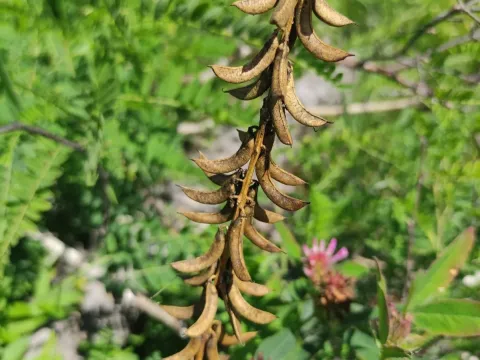
Sickle milkvetch
Astragalus falcatus
Sickle milkvetch is a perennial herbaceous plant belonging to the Fabaceae family. As the culture grows slowly during its first year, the optimal time for sowing is early spring when the soil retains maximum moisture levels.
What the section contains
Sickle milkvetch
Winter sowing is also a viable option, allowing the seeds to undergo natural stratification. This leads to more uniform germination after the snow melts and helps the plant establish a root system before the onset of summer heat.
For establishing a grassland, a cover-free sowing method is recommended. It is essential to ensure deep seed placement, as the seeds have a dense coat that requires good contact with moist soil to germinate effectively.
The seeding rate is determined by the purity and viability of the material, typically ranging from 10 to 15 kilograms per hectare. When grown for seed production, wider row spacing is preferred, whereas standard row seeding is acceptable for green mass production.
Post-sowing, field rolling is advised to improve capillary moisture flow to the seeds. During the first growing season, strict weed control is necessary, as the crop is less competitive in the initial growth stages.
Sickle milkvetch demonstrates exceptional resistance to unfavorable climatic factors. It withstands harsh winter frosts and spring returning freezes, making it a promising crop for northern agricultural regions.
The plant is highly drought-tolerant due to its deeply penetrating, powerful root system. This allows the crop to thrive in moisture-deficient environments where other standard pasture grasses would wither.
While the plant is relatively undemanding regarding soil types, it achieves the best yields on chernozem and chestnut soils with good aeration. It is capable of growing on eroded or rocky lands where other legumes might fail.
The most important requirement is the absence of prolonged groundwater stagnation. Waterlogging leads to root rot and stand thinning, so well-drained locations should always be prioritized for cultivation.
For optimal nitrogen fixation, the soil should have a neutral or slightly alkaline reaction. Liming is recommended on acidic soils, as this practice significantly enhances the overall productivity of the perennial stand.
The productivity of sickle milkvetch depends on the age of the stand and the level of agricultural management. Peak yields of green mass are typically observed during the third and fourth years of life as the root system matures.
In favorable years, the crop can provide two full harvests when utilized as a forage plant. Average green mass yields can range between 20 to 30 tonnes per hectare, depending on local environmental conditions.
Agricultural use includes hay production, haylage, and direct grazing. It is important to note that the forage is highly nutritious and palatable to all types of farm animals, making it an excellent feed source.
Seed production is also quite high, supporting sustainable integration into crop rotations. With proper maintenance, a single field can remain productive for 10–15 years without needing to be re-sown.
The symbiotic relationship with nitrogen-fixing bacteria living in the root nodules enriches the soil with nitrogen. This makes sickle milkvetch a superior precursor crop for cereals in broader field rotations.
Sickle milkvetch exhibits high resistance to most common diseases affecting legumes. Its phytosanitary status remains stable even under long-term cultivation on the same plot, reducing the need for fungicide treatments.
Under conditions of high humidity, rare cases of powdery mildew or rust may occur. However, these infections rarely reach epidemic proportions and do not generally require intensive chemical intervention.
Among pests, clover root curculios pose the greatest risk, as they damage roots and reduce nitrogen-fixing efficiency. Preventive measures include proper field isolation and effective crop rotation cycles.
During the flowering period, phytophagous insects like seed-eating weevils may damage seed heads. Insecticide application during the budding stage might be necessary only if insect density exceeds established economic thresholds.
Overall, the plant has a strong immune system and high competitiveness against weeds. This effectively minimizes expenditure on pesticides, making it a cost-effective choice for industrial-scale cultivation.
Harvesting for green mass or hay is performed at the early flowering stage. At this phase, the plant contains the highest concentrations of protein, vitamins, and minerals required for high-quality livestock feed.
Mowing is done with standard machinery. If haylage is the goal, immediate processing is used, while hay production requires a drying period. The plant dries well and retains its leaves, which are crucial for nutritional value.
When harvesting for seeds, it is important to monitor the uniform ripening of the pods. Collection begins when most pods turn brown to prevent seed shattering during mechanical harvesting operations.
The seeds have a very hard coat, so post-harvest cleaning and proper drying are essential. Storing the seeds in dry, well-ventilated areas is necessary to prevent mold development and maintain long-term viability.
After the final cut, harrowing the stand is recommended to remove dead plant residue and stimulate spring regrowth. This simple practice extends the active life of the plantation and enhances annual yield stability.