
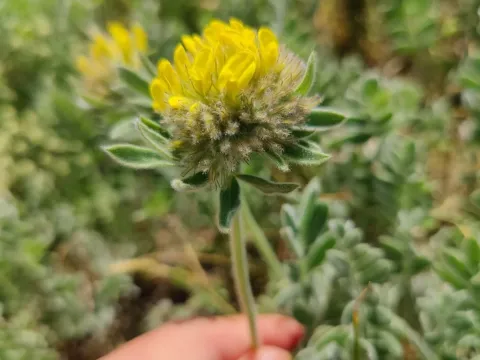
Golden Anthyllis
Anthyllis aurea
Golden Anthyllis (Anthyllis aurea) is a perennial legume that is valued in sustainable agriculture for its hardiness and nitrogen-fixing properties. Sowing should ideally take place in early spring, once the soil has warmed sufficiently to ensure rapid germination and initial seedling establishment.
What the section contains
Golden Anthyllis
The seeds are relatively small, which dictates a shallow planting depth of approximately 1-2 centimeters. Achieving a fine, firm seedbed is essential to ensure good soil-to-seed contact, which promotes uniform emergence and helps the plants compete with weeds during their early development.
In the first year, the crop focuses on establishing a robust root system and a basal rosette of leaves. Because its growth is somewhat slow during this initial phase, effective weed control is paramount to prevent the seedlings from being suppressed by more aggressive vegetation.
Row planting with a spacing of about 15 centimeters is standard practice, although wider spacing may be used if the primary goal is seed production. This arrangement ensures that each plant receives adequate space, light, and nutrients as it matures into its second and third years.
When including Golden Anthyllis in seed mixtures for pastures, it is recommended to pair it with compatible non-aggressive grasses. This helps to create a balanced forage stand that remains productive over multiple seasons, contributing to soil health through symbiotic nitrogen fixation.
This crop thrives in well-drained, lime-rich soils and is particularly well-suited to sites with alkaline to neutral pH levels. It performs exceptionally well on rocky or calcareous soils where other forage crops might struggle to obtain necessary nutrients.
Golden Anthyllis is recognized for its high drought tolerance, making it an excellent choice for regions with limited rainfall. Its deep taproot allows the plant to access moisture reserves in the subsoil, ensuring that it remains green and productive even during dry summer months.
Exposure to full sunlight is critical, as the plant does not tolerate shading well. Site selection should prioritize open areas with good air circulation to reduce the incidence of fungal diseases that can occur in damp or stagnant conditions.
The fertility requirements are relatively modest, focusing primarily on phosphorus and potassium to support root development and overall plant resilience. Nitrogen fertilization is rarely required, as the crop effectively manages its nitrogen supply through symbiotic bacteria in its root nodules.
The species is highly frost-hardy, allowing it to survive harsh winters without significant plant mortality. Proper site drainage remains the most important soil management factor to prevent waterlogging, which the species finds detrimental during the winter dormancy period.
The forage yield of Golden Anthyllis depends largely on environmental conditions and the management of the pasture or meadow. Under optimal conditions, the crop can provide multiple cuts, offering a high-protein feed source that is particularly beneficial for ruminant livestock.
For high-quality hay production, harvesting should be performed at the early flowering stage. This is the period when the plant provides the best balance between digestible protein content and structural fiber, ensuring optimal nutritional value for farm animals.
As a notable pollinator plant, Golden Anthyllis serves a dual purpose by supporting local honeybee populations. This ecosystem service can lead to increased biodiversity on the farm and may even provide a secondary source of income through honey production.
To maintain high productivity in long-term stands, it is necessary to manage grazing or mowing carefully. Periodic rest periods are required to allow the plants to replenish their root energy reserves, which ensures longevity and consistent yield across multiple years.
Seed production requires careful timing, as the flowers are often cross-pollinated by insects. For specialized seed-producing farms, ensuring that pollinator populations are sufficient is essential to maximizing the yield and quality of the harvested seeds.
Golden Anthyllis is generally resistant to many common legume pests, but it remains susceptible to fungal diseases such as powdery mildew in areas with high humidity or poor air movement. Proper plant spacing is the best preventative strategy for maintaining a healthy stand.
Root-feeding pests like weevils can cause significant damage to young stands by consuming the root tissue and weakening the plant. Crop rotation is the most effective cultural control method to break the life cycle of these pests and protect the crop's long-term health.
In very dry conditions, aphids may colonize the flower heads and succulent stems, potentially reducing both the yield and the quality of the harvest. Integrated pest management practices should be used, emphasizing biological controls to preserve the pollinator presence.
Root rot diseases are primarily associated with poorly drained soils. Farmers should avoid low-lying, waterlogged areas for planting to minimize the risk of pathogen outbreaks that can decimate the crop during wet seasons or early spring thaws.
Weed encroachment is the primary competitive threat, especially in the first growing season. Consistent monitoring and the use of mechanical weed control or selective mowing can help maintain the crop's dominance until it has fully established itself in the field.