
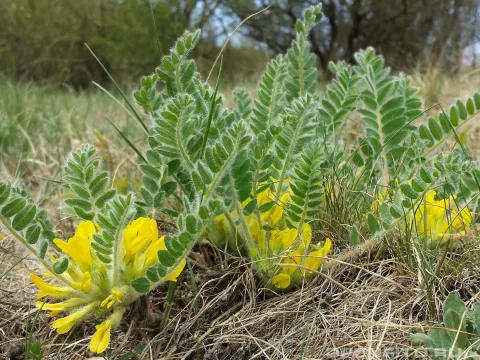
Goat milkvetch
Astragalus caprinus
Goat milkvetch (Astragalus caprinus) is a member of the Fabaceae family, known for its significant adaptability to arid and semi-arid environments. This perennial plant is highly regarded for its ability to thrive where other forage crops fail.
What the section contains
Goat milkvetch
The plant possesses an extensive root system, which helps it access deep-seated soil moisture. This morphological adaptation makes it an excellent candidate for stabilizing sandy soils and preventing erosion in degraded landscapes.
It prefers well-drained soil conditions and shows remarkable tolerance to salt-affected lands. Waterlogging is detrimental to the plant, so agricultural site selection should prioritize well-aerated areas that prevent standing water.
Agricultural techniques for this species include ensuring a weed-free seedbed during the establishment phase, as young seedlings can be slow to grow initially. Once established, the plant becomes highly competitive against weeds due to its dense growth habit.
Climatic requirements are centered on high light intensity and thermal stability. The crop is frost-hardy and can withstand significant seasonal temperature fluctuations, making it suitable for continental climatic zones.
The primary agricultural utility of Goat milkvetch lies in its high protein content, making it a valuable resource for livestock fodder. It is particularly effective as a component in sustainable forage systems where inputs must be minimized.
Yield metrics are largely determined by the frequency of precipitation and the overall nitrogen-fixing capacity of the local soil microbiome. As a nitrogen-fixing legume, it actively contributes to soil enrichment, reducing the need for synthetic fertilizers.
The longevity of the stand is a major economic benefit. Once the field is successfully established, it can provide reliable harvests for several years, which significantly improves the economic efficiency of the farming cycle.
Harvesting for seed production requires careful management of the ripening process. Due to uneven maturation, farmers often employ multi-stage harvesting techniques to ensure the maximum recovery of viable, mature seeds for future planting.
Beyond animal nutrition, the plant is studied for its chemical profile, which includes bioactive compounds. This dual-purpose potential—as fodder and a raw material for biochemical extraction—makes it a fascinating subject for modern agricultural research.