
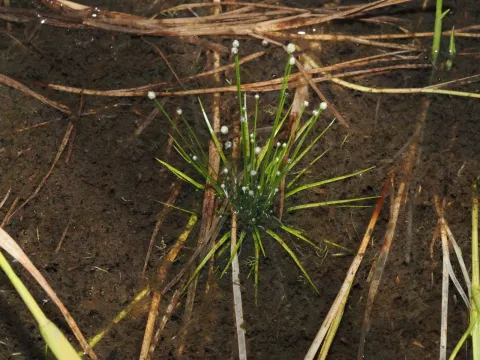
Eriocaulon redactum
Eriocaulon redactum
Eriocaulon redactum belongs to the Eriocaulaceae family and is a highly sought-after species for sophisticated aquascaping. Native to tropical regions of Asia, it inhabits wetland areas characterized by acidic substrates and soft, flowing water, which dictates its specific requirements in captive conditions.
What the section contains
Eriocaulon redactum
The plant features a compact, rosette-forming structure with rigid, needle-like leaves. Its slow growth rate and miniature size make it an excellent choice for the foreground of an aquarium, where it maintains a dense, tufted appearance that adds texture to the underwater layout.
To successfully cultivate this species, keeping the water chemistry within precise parameters is essential. Soft water with low carbonate hardness (kH) is mandatory, as elevated mineral levels can cause the plant to stunt and eventually disintegrate after a period of poor health.
Lighting requirements are categorized as high to very high. Consistent illumination is necessary to maintain the plant's structural integrity; without a strong light source, the plant will lose its compact form and eventually fail to perform vital metabolic functions.
Effective agrotechnical practices include the injection of pressurized CO2 and the use of nutrient-rich, layered substrates. As the plant absorbs most of its minerals through the root system, the quality of the soil is the single most important factor for long-term survival.
The primary threats include colonization by epiphytic algae, which outcompete the plant for nutrients and light. Once the leaves are covered in green dust or hair algae, the plant's photosynthesis is severely impeded, leading to the rapid decline of the entire rosette.
Root rot, often caused by overfeeding or the accumulation of organic debris in the substrate, is a common problem. Maintaining optimal water circulation and regular maintenance of the substrate is vital to preventing the hypoxia that leads to root zone failure.