
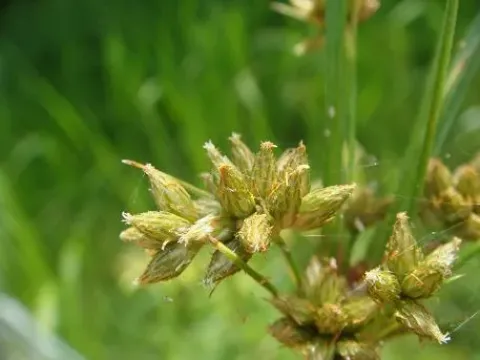
Fuirene sedge
Scirpus fuirenoides
Fuirene sedge (Scirpus fuirenoides) belongs to the Cyperaceae family, commonly known as the sedge family. It is a perennial herbaceous plant adapted to semi-aquatic and wetland environments.
What the section contains
Fuirene sedge
The plant propagates primarily through seeds and vegetative rhizome expansion, allowing it to naturally colonize stable wetland zones with sufficient moisture.
Sowing should ideally occur in early spring when the soil temperature consistently supports germination, ensuring that young seedlings have enough time to establish their root systems before the onset of extreme weather.
For agricultural purposes, planting in nursery beds with controlled water levels provides the best conditions for early development before transplanting into permanent wetland areas.
Proper spacing is crucial to prevent seedling overcrowding, which can inhibit the development of healthy, robust stalks and reduce overall biomass quality.
The primary requirement for Scirpus fuirenoides is a consistent supply of water, as it is a hydrophytic species that flourishes in saturated soils or shallow standing water.
It prefers nutrient-rich organic soils, such as silt or peat deposits found in river floodplains, which provide the essential elements required for its rapid growth cycle.
Full sun exposure is preferred for maximum productivity, as high photosynthetic rates are needed to support the dense biomass formation typical of this sedge species.
The climate should be moderate, as sudden temperature drops or prolonged drought stress can significantly impair the physiological functions of the plant, leading to stunted growth.
Successful management requires strict control of the hydrological regime to maintain soil moisture levels and prevent the intrusion of invasive species that compete for resources.
The yield potential of Fuirene sedge is closely linked to the fertility of the aquatic environment and the nutrient load of the surrounding ecosystem.
In industrial agriculture, the crop is valued for its fiber content, which can be processed into various industrial materials, including woven products and bio-based insulation.
The crop also plays a vital role in phytoremediation, as it is highly effective at absorbing excessive nitrogen and phosphorus from agricultural runoff and wastewater systems.
Sustainable harvesting cycles allow for recurring annual yields, provided the rhizomes remain healthy and the environmental conditions are not overly depleted by harvesting activity.
Economic efficiency is enhanced by utilizing the sedge in integrated wetland systems, where it provides both environmental filtration services and secondary raw material production.
Fungal pathogens represent the most significant threat, particularly in stagnant water environments where poor aeration promotes the growth of rot-inducing organisms.
Various insect pests can damage the inflorescences, thereby reducing the production of viable seeds and impacting the long-term sustainability of the sedge population.
Competition from more aggressive wetland weeds often requires manual or biological control measures to ensure that the Fuirene sedge remains the dominant plant species in the area.
Pollution from heavy metals or herbicide runoff from neighboring agricultural fields can be toxic to the plant, compromising both its growth rate and its environmental safety.
Rodents and other small mammals may pose a threat by feeding on the rhizomes during periods of low water, which can severely damage the plant's ability to survive the season.
Harvesting is typically performed at the end of the growing season when the stalks have matured and reached their maximum fiber density, ensuring higher quality raw material.
Mechanized harvesting, often using amphibious equipment, is necessary to minimize disturbance to the sensitive bottom soil and prevent long-term damage to the plant's root structure.
Post-harvest processing involves immediate drying to reduce the moisture content, which is essential to prevent degradation and mold formation during storage.
The biomass is usually sorted and pressed into bales to facilitate efficient transport and storage in facilities designed for high-volume agricultural products.
Storage facilities must be well-ventilated and kept away from direct moisture to ensure the long-term stability and quality of the processed plant material.