
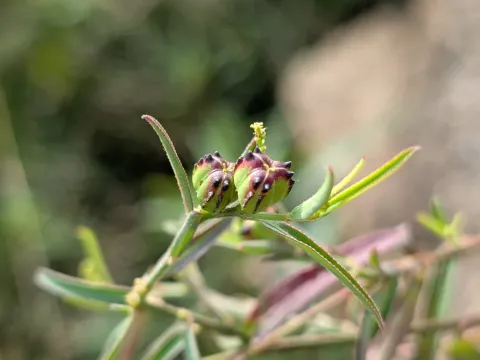
Sebastiania chamaelea
Sebastiania chamaelea
Sebastiania chamaelea is primarily a wild-growing species, so there are no strictly defined industrial sowing schedules for it. Under natural environmental conditions, seed germination usually occurs at the beginning of the rainy season when soil temperatures stabilize above 22-25 degrees Celsius.
What the section contains
Sebastiania chamaelea
When cultivating under controlled conditions, seeds should be sown in a prepared substrate immediately after ripening, as they lose viability quickly if stored for long periods. The optimal sowing depth is no more than one centimeter to ensure sufficient light exposure for germination.
To accelerate the germination process, pre-soaking seeds in warm water or mild growth stimulants is recommended. Sowing should be carried out in light, well-draining soil mixed with sand to prevent moisture accumulation around the root neck of young plants.
In regions with distinct seasonality, using a seedling method helps protect the crop from adverse environmental factors during early growth stages. Transplanting seedlings into open ground is best performed after the weather has become consistently warm, eliminating the risk of cold soil shock.
Planting density varies depending on the cultivation goals, averaging between 20,000 to 40,000 plants per hectare. Maintaining optimal spacing between rows facilitates easier agricultural maintenance and improves overall ventilation within the plantation.
Sebastiania chamaelea belongs to the Euphorbiaceae family and grows as a perennial herbaceous plant or small subshrub. The crop prefers open, sunny locations but is capable of tolerating light shading during the hottest parts of the day.
The plant shows high adaptability to various soil types, including sandy and rocky soils with low nutrient profiles. However, for maximum vegetative mass production, fertile sandy loam soils with a neutral or slightly acidic pH are preferred for optimal development.
Moisture requirements are moderate: the crop displays a certain degree of drought tolerance, allowing it to survive in regions with irregular rainfall. Excessive soil waterlogging is detrimental to the root system and can promote the development of fungal infections.
The optimal temperature range for active growth and development is between 20 and 32 degrees Celsius. The plant is sensitive to low temperatures and cannot withstand frosts, which limits its primary cultivation range to tropical and subtropical climate zones.
Standard agronomic practices include regular weeding and hoeing between rows to improve root aeration and reduce weed competition. Applying mineral fertilizers rich in phosphorus and potassium helps strengthen plant tissue and increases resistance to environmental stressors.
The biomass yield of Sebastiania depends heavily on the quality of care and the climatic conditions of the cultivation region. With proper agronomic management, the plant can produce multiple green mass harvests per growing season, which is valuable for medicinal raw material production.
Commercial utilization of this crop is focused on harvesting aerial parts that contain biologically active compounds. Quantitative yield data per hectare varies significantly, as this plant is not currently a mass-produced agricultural commodity.
Seed collection for propagation is performed manually as they ripen to prevent the pods from bursting and scattering seeds spontaneously. Collection efficiency is highly dependent on timing, as the fruits have a tendency to drop quickly once mature.
In commercial cultivation for essential oil or extract production, uniform maturation across all tiers of the plant is critical. Regulating vegetation cycles through irrigation management allows for better standardization of the finished raw material output.
Productivity potential increases with the application of organic fertilizers, which enhance soil structure over time. Stable annual yields are possible if the integrity of the root system of perennial specimens is preserved throughout 3-5 years of active production.
Sebastiania chamaelea possesses natural defenses against many pests due to its milky sap, which contains alkaloids and other toxic compounds. Nevertheless, in high-humidity conditions, the plant is susceptible to root rot diseases.
Common pests include sucking insects such as aphids and spider mites, which can infest young shoots in large numbers. The application of contact-action insecticides is an effective method to manage and reduce pest populations within commercial plantations.
Powdery mildew represents a serious threat to the aerial parts of the plant, manifesting as a whitish fungal coating on the leaves. Prevention includes maintaining proper planting density to ensure sufficient airflow and the timely application of fungicides.
In some regions, seedlings can be damaged by soil-dwelling nematodes, leading to stunted growth and leaf yellowing. Implementing crop rotation and pre-planting soil treatments are essential strategies to minimize the risk of soil-borne infections.
Regular crop monitoring should be conducted on a weekly basis, especially during humid weather periods. Promptly removing affected specimens prevents the spread of pathogens throughout the field and helps maintain the overall productivity of the crop.
Harvesting of the aerial mass is performed during the flowering period, when the concentration of active compounds in the plant reaches its maximum. At this stage, essential oils and medicinal compounds are most stable, ensuring the highest quality of raw material.
The harvesting technology involves using sharp cutting tools to minimize injury to the underlying root system. Harvested material should be immediately cleaned of debris and prepared for the drying or initial processing stage to maintain quality.
Drying is conducted in well-ventilated rooms or specialized drying units at temperatures not exceeding 40 degrees Celsius. Excessive overheating causes the evaporation of volatile useful components and significantly reduces the pharmacological value of the product.
For long-term storage, the dried herb is packed into airtight containers, protected from direct sunlight and moisture. Under these conditions, the biological activity of the raw material can be maintained for 12-24 months if proper temperature regulation is observed.
Proper harvest organization includes grading raw materials based on quality characteristics, which simplifies subsequent marketing or further industrial processing. Using modern packaging materials allows for a significant reduction in losses during transportation and warehousing.