
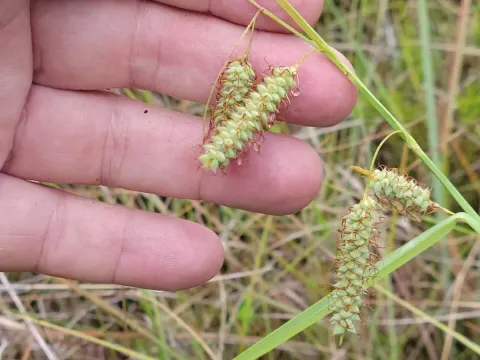
Glaucous sedge
Carex glaucescens
Glaucous sedge (Carex glaucescens) is a member of the Cyperaceae family, recognized for its clump-forming growth habit and specific adaptation to moist environments.
What the section contains
Glaucous sedge
Propagation is most effective through seed stratification during winter months, which breaks dormancy and ensures a high germination rate in the spring.
For vegetative propagation, mature clumps are divided into smaller sections, ensuring that each segment retains a healthy portion of the fibrous root system.
The optimal planting density is essential for achieving a uniform cover, usually requiring a spacing of approximately 30 to 45 centimeters between individual plants.
Early spring is considered the primary window for sowing, as it allows the root system to establish thoroughly before the onset of high summer temperatures.
This species thrives in high-moisture conditions, making it an ideal candidate for riparian restoration projects, rain gardens, and wet meadow landscapes.
It prefers full sun exposure to maintain its characteristic glaucous blue-green foliage, although it can successfully adapt to partial shade settings.
Regarding soil preference, Carex glaucescens requires nutrient-rich, moist substrates, often performing best in acidic or neutral pH ranges.
Climate tolerance is significant; the plant is well-adapted to varied seasonal changes, showing strong resilience to cold winters provided there is consistent soil moisture.
Agricultural management should prioritize the maintenance of water levels, as severe drought will quickly lead to leaf tip dieback and stunted biomass accumulation.
Carex glaucescens generally exhibits strong natural resistance to common agricultural pests and diseases due to its native adaptation to harsh wetland ecosystems.
Occasional fungal outbreaks, such as leaf spot or rust, may occur under conditions of extremely high humidity and limited airflow in dense plantings.
Pest pressure from aphids or spider mites is typically negligible but can increase if plants are stressed by poor soil quality or improper water management.
Good horticultural practice involves regular clearing of debris around the base of the plants to prevent the accumulation of moisture-loving pathogens.
Integrated pest management strategies focusing on cultural control and occasional organic treatments are sufficient to maintain healthy populations of this sedge.