
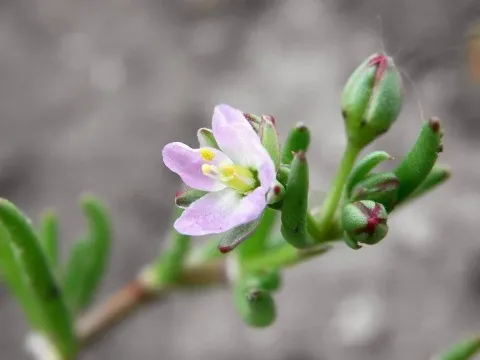
Sea sandspurry
Spergularia maritima
Sea sandspurry (Spergularia maritima) is a member of the Caryophyllaceae family, recognized as an obligate halophyte. Its botanical structure is optimized for survival in high-salinity environments, utilizing osmotic adjustment to thrive where standard crops fail.
What the section contains
Sea sandspurry
The plant originates from coastal salt marshes and sandy shores across Europe and the Mediterranean. It is naturally adapted to withstand tidal inundation and shifting substrates, exhibiting a perennial or annual growth cycle depending on local climate.
Environmental requirements focus on high solar radiation and saline soil conditions. It does not demand high-nutrient soils, making it an excellent candidate for utilizing marginal land that has been impacted by salt accumulation or seawater intrusion.
Soil management for this species is minimal, as it prefers alkaline, saline-rich sands or silts. Irrigation, if practiced, must maintain a specific salt concentration to prevent the plant from losing its competitive edge against glycophytic weed species.
In terms of agricultural utility, Sea sandspurry is currently being investigated for its potential in saline agriculture, soil stabilization, and as a potential source of halophytic biomass for sustainable forage systems.
As a specialized halophyte, Sea sandspurry is remarkably resistant to typical agricultural pathogens. The high internal salt concentration in its tissues serves as an effective biochemical barrier against many common fungal and bacterial infections.
Potential threats include specialized coastal insect pests that feed on halophytic flora. However, in controlled agricultural settings, these infestations are rarely severe enough to cause significant economic damage or require chemical intervention.
The primary abiotic threat is waterlogging caused by poor drainage. While the plant can tolerate salinity, constant saturation of the soil can lead to root rot if the oxygen supply to the rhizosphere is restricted.
Competition from non-halophytic weeds is generally low in highly saline areas, but on less saline sites, early weed control is necessary to allow the crop to establish a dense canopy.
Standard integrated pest management (IPM) practices are typically sufficient to manage any secondary threats, ensuring the health and stability of the Sea sandspurry crop throughout its growth cycle.