
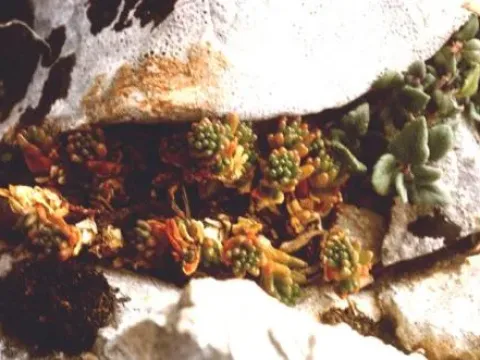
Sedum idaeum
Sedum idaeum
Sedum idaeum is a succulent perennial plant belonging to the Crassulaceae family. Native to the mountainous regions of Crete, this species is adapted to rocky environments, showcasing remarkable resilience in nutrient-poor and harsh climatic conditions.
What the section contains
Sedum idaeum
The plant features a low-growing, mat-forming habit with fleshy leaves that store water, enabling it to survive periods of extreme drought. These morphological traits make it an excellent candidate for xeriscaping and soil erosion control on steep rocky slopes.
Regarding soil requirements, Sedum idaeum demands extremely well-draining substrates, such as sandy or gravelly mixes. Waterlogged soil is the primary enemy of this species, as it rapidly causes root rot and compromise the integrity of the succulent tissues.
Sunlight exposure is essential for the healthy development of this crop. Full sun conditions are required to maintain the plant's characteristic compact habit and vibrant foliage color, as shading often leads to etiolation and a loss of aesthetic value.
Temperature tolerance for Sedum idaeum is balanced; while it tolerates Mediterranean heat, it requires a dry dormant period during the winter. Ensuring adequate air circulation around the plants helps to mitigate the impact of environmental humidity.
In terms of agricultural and horticultural use, Sedum idaeum is primarily cultivated for the landscape industry. Propagation is achieved through vegetative cuttings, which is the most effective and reliable method for maintaining the purity of the stock.
Cuttings should be harvested during the active growing season. After removal, it is beneficial to allow the cut ends of the stems to callus over for a few days in a shaded area, which prevents pathogen entry when placed in the propagation medium.
Harvesting of plant material in nurseries is performed manually to ensure minimal damage to the succulent leaves. Careful handling during the extraction and transplanting process is crucial for establishing strong, healthy plants for retail or design projects.
While the plant produces flowers in the summer, the primary harvest focuses on vegetative mass for propagation. If seed collection is desired, one must wait until the seed capsules are fully matured and dried on the mother plant.
Maintenance of the crop involves periodical pruning or thinning of mature mats to prevent the center of the plants from becoming woody or bare. This practice ensures that the patch remains dense and continues to provide the intended ecological or aesthetic benefits.