
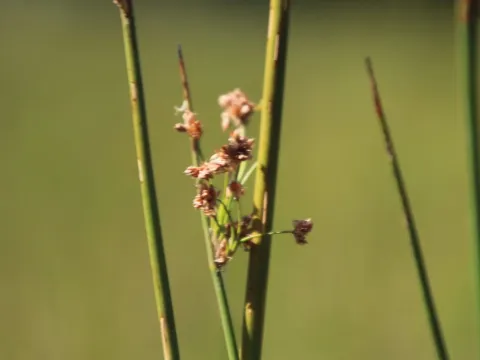
Club-rush
Schoenoplectus corymbosus
Club-rush (Schoenoplectus corymbosus) is a perennial herbaceous plant belonging to the Cyperaceae family. It is a specialized hydrophyte that naturally thrives in shallow wetlands, lake margins, and riverbanks, where it plays a critical role in local ecosystem stability.
What the section contains
Club-rush
The plant originates from tropical and subtropical climates, primarily found across the African continent and the Middle East. It requires abundant sunlight for photosynthesis, as its rapid growth habit demands high energy levels to produce its characteristic sturdy culms.
Regarding cultivation requirements, this species favors water depths ranging from 10 to 60 centimeters. It is highly tolerant to variations in water levels, allowing it to adapt to fluctuating riparian environments where soil moisture remains consistent throughout the season.
The ideal soil conditions consist of nutrient-rich silt, peat, or loamy sediments. The plant excels in environments with high levels of organic nitrogen and phosphorus, which are frequently replenished by natural flooding and sedimentation processes in its native range.
Agricultural management involves regular monitoring of stand density to prevent competition and ensuring that the water quality remains conducive to growth. In controlled environments, maintaining a steady, warm temperature is essential for preventing frost damage to the root system.
The economic value of Club-rush is primarily derived from its durable, fibrous stems. Historically, it has been a staple material for weaving baskets, floor mats, and traditional roofing, owing to its flexibility when hydrated and strength when dried.
Harvesting should be timed to coincide with the end of the peak growing season, ensuring that the stems have reached maximum maturity and fiber development. Typically, this harvest occurs in late summer, which allows for sufficient drying time before the onset of autumn rains.
Post-harvest processing involves air-drying the biomass in a shaded, well-ventilated area. Proper drying is crucial to avoid microbial decay, which can compromise the structural integrity and aesthetic value of the fibers for artisanal crafts.
In modern agriculture, Schoenoplectus corymbosus is increasingly utilized for phytoremediation. Its high uptake capacity for nutrients makes it an efficient biological tool for filtering agricultural runoff and managing water quality in artificial wetlands.
Future industrial potential lies in the production of cellulose and biofuel feedstock. As a fast-growing, renewable resource that thrives in areas unsuitable for traditional food crops, it offers a sustainable alternative for biomass production in integrated water management systems.