
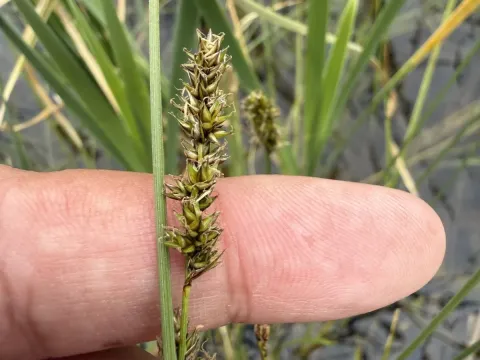
Lesser tussock-sedge
Carex diandra
Lesser tussock-sedge (Carex diandra) is a member of the Cyperaceae family. This perennial herbaceous plant is widely distributed across the Northern Hemisphere, inhabiting peatlands, fens, and the margins of water bodies. It is a vital component of wetland plant communities.
What the section contains
Lesser tussock-sedge
Botanically, it is characterized by its tufted growth habit, originating from short rhizomes. The stems are slender and triangular, reaching heights of 30 to 70 cm. The leaves are narrow and distinctly grey-green, typically shorter than the inflorescence, which is a dense, brown-flowered spike-like panicle.
Regarding ecological requirements, Carex diandra is a true hydrophyte. It thrives in habitats where the water table is at or above the soil surface for the majority of the growing season. It prefers neutral to slightly acidic peat soils and requires constant moisture to sustain its physiological functions.
The plant is highly adaptable to cool and temperate climates. It exhibits excellent winter hardiness, allowing it to survive in harsh northern environments where frost is frequent. The success of this sedge is heavily dependent on maintaining the delicate balance of the local hydrological regime.
While not a traditional industrial crop, this sedge is valuable for ecological restoration and wetland conservation. Its root systems help stabilize organic soils, and it plays a significant role in carbon sequestration within fen ecosystems, serving as a natural buffer in water management.
The primary threat to lesser tussock-sedge populations is the large-scale drainage of peatlands for agriculture or peat extraction. Such interventions alter soil aeration, making the habitat unsuitable for this moisture-loving species.
Fungal pathogens, particularly rusts (Puccinia species), can affect the vitality of the sedge, although outbreaks are generally restricted to periods of high humidity and stress.
Invasive plant species can outcompete Carex diandra when the nutrient status of the water increases, as this sedge prefers nutrient-poor or oligotrophic conditions.
Grazing by large herbivores in uncontrolled settings can also reduce the seed set of the plants, affecting the long-term regeneration of the local population.
Chemical runoff from nearby cultivated areas, containing high levels of nitrogen or phosphorus, causes shifts in the plant community that often exclude Carex diandra in favor of faster-growing grasses.