
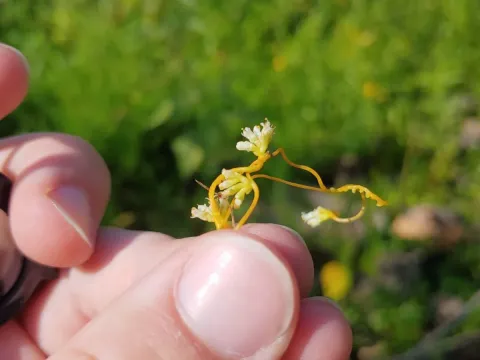
Buttonbush dodder
Cuscuta cephalanthi
Buttonbush dodder (Cuscuta cephalanthi) is an obligate parasitic plant belonging to the Convolvulaceae family. It is strictly categorized as a weed rather than a crop, often serving as a detrimental invasive species that significantly reduces the productivity of wild and cultivated vegetation.
What the section contains
Buttonbush dodder
Native to North America, this species has successfully naturalized in various regions. It is frequently found in wetlands and riparian habitats, where it parasitizes native shrubs and herbs before spreading to nearby agricultural crops, causing significant economic damage.
Morphologically, the dodder consists of slender, leafless, twining stems. It lacks chlorophyll and cannot perform photosynthesis. Instead, it forms specialized structures called haustoria that penetrate the stems of host plants to derive water and nutrients essential for its growth and reproduction.
The life cycle of the buttonbush dodder is highly opportunistic. Once the seed germinates, the thin seedling must quickly contact a host plant. Once attached, it loses connection to the soil and becomes entirely dependent on the host, rapidly growing and producing tiny clusters of flowers.
Managing this pest requires strict adherence to agricultural quarantine regulations. Mechanical destruction of infested patches, burning of affected biomass, and chemical control through selective herbicides are the primary methods used by agronomists to prevent the spread of this parasitic plant.