
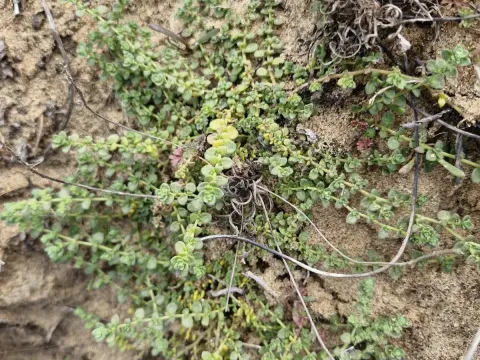
Shore rupturewort
Herniaria maritima
Shore rupturewort is a perennial herbaceous plant that requires specific conditions for successful seed germination. Sowing is recommended in late autumn or early spring, using stratified seeds to increase the germination rate.
What the section contains
Shore rupturewort
The seeds of this plant are very small, so they should be sown at a depth of no more than 0.5 cm. The optimal sowing method is surface distribution over moist substrate, followed by a light covering with sand or loose soil.
For industrial cultivation, it is necessary to maintain an optimal planting density. The spacing between rows should be about 25–30 cm, allowing the plant to fully develop and form a dense mat that suppresses weeds.
Using the seedling method ensures uniform germination and reduces the initial rooting period in open fields. Seedlings should be transplanted to their permanent location after the danger of night frosts has passed, ensuring regular watering until they are established.
A crucial condition is choosing a site free from perennial rhizomatous weeds. Shore rupturewort grows slowly in the first months of its life, so competition with fast-growing weeds can lead to the death of young seedlings.
This crop belongs to the Caryophyllaceae family and grows naturally on sand dunes and coastal areas. For successful cultivation, it is vital to provide conditions similar to its natural environment, specifically excellent drainage and light soil structure.
The plant prefers sunny, well-lit areas. Shading negatively affects the biochemical composition of the herb and leads to spindly growth, which lowers the quality of the raw material.
Shore rupturewort is moderately demanding regarding soil pH, with an optimal level between 6.5 and 7.5. Poor sandy or loamy soils are preferred, as an excess of nitrogen fertilizers can lead to a loss of specific medicinal properties.
Climatic requirements include high resistance to drought and wind. The plant can withstand long periods without rainfall, but moderate watering is desirable during the mid-vegetation stage to ensure sufficient biomass yield.
The plant is winter-hardy and can withstand low temperatures, but it is sensitive to waterlogging during spring thaws. Therefore, areas with standing water are strictly unsuitable for this crop.
The productivity of Shore rupturewort depends on stand density and timing of the harvest. Dry above-ground biomass yields can reach 1.5–2 tons per hectare under favorable conditions in perennial plantations.
Maximum biomass yield is observed in the second or third year of the plant's life, as it spreads horizontally. During this period, intense monitoring of the mat condition is necessary to prevent bald spots in the center of the patches.
The economic value of the plant is determined by its content of biologically active substances, including saponins and flavonoids. High-quality raw material must be collected strictly during the mass flowering period to reach the peak concentration of these compounds.
To increase production profitability, it is recommended to combine medicinal herb collection with seed propagation. Leaving a portion of the field for seed production provides self-sufficiency for future cultivation cycles.
After harvesting, the plantations recover quickly due to the vegetative spreading of side shoots. With proper care, the productive lifespan of a single field can be up to 5–7 years.
Shore rupturewort is considered a relatively resistant crop; however, if agronomic practices are neglected, it can be affected by fungal diseases. The most dangerous is root rot, which occurs when moisture stagnates in the plant's root collar zone.
In high-humidity conditions, powdery mildew can develop. The first signs are white coatings on leaf blades, which require immediate treatment with biological fungicides or the removal of affected areas to prevent the infection from spreading.
Among pests, soil-dwelling insect larvae, such as wireworms, are the most dangerous as they gnaw on the roots of young plants. Prevention includes pre-sowing soil treatment and adhering to crop rotation practices.
Aphids and spider mites may infest the plants during dry periods. Upon reaching a threshold number, approved insecticides or phytopreparations that do not accumulate in medicinal raw materials can be used.
An important element of phytosanitary control is removing fallen leaves and plant debris in the autumn. This reduces the risk of pathogen spores overwintering and ensures a healthy start to the next growing season.
Harvesting is carried out during the phase of mass flowering, as the plant possesses its highest pharmacological activity at this time. Depending on the region, harvest periods vary from June to August.
Mowing the green mass is done at a height of 3–5 cm above the soil surface. Using professional lawn mowers or sickles allows for a clean cut, which promotes the quick regrowth of the crop.
The collected biomass must be sent for drying immediately to avoid overheating and degradation. The optimal drying temperature is 35–40 degrees Celsius in well-ventilated rooms or drying units.
After drying, the raw material must be cleaned of foreign impurities, weeds, and darkened parts. Properly dried herbs retain their natural color and a specific faint odor.
The final product should be packed in paper bags or cloth containers to allow air circulation. Storage must occur in dry, dark warehouses with controlled humidity to avoid loss of the product's biological value.