
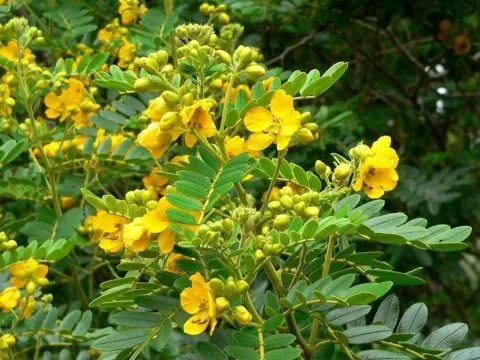
Cassia angustifolia
Cassia angustifolia
Cassia angustifolia, commonly known as Senna, is a warm-season crop that requires careful management of sowing timing. In commercial farming, sowing is performed in the spring once soil temperatures at a depth of 10 cm consistently reach +15...+18°C.
What the section contains
Cassia angustifolia
Pre-sowing treatment, including scarification of seeds, is crucial to enhance germination rates. Sowing is typically done in wide rows with inter-row spacing of up to 60 cm to ensure optimal light penetration and root development.
The planting depth ranges from 2 to 3 cm, depending on soil texture. During the initial weeks after sowing, maintaining loose soil conditions is vital to prevent the formation of a surface crust that could hinder seedling emergence.
Plant density is an essential factor for biomass production, usually aiming for 150,000 to 200,000 plants per hectare. Excessive density may negatively impact plant vigor and increase susceptibility to diseases.
When using transplanting methods in cooler climates, seedlings should only be moved to the field after the risk of frost has completely passed, as the plant is highly sensitive to cold stress.
As a member of the Fabaceae family, Cassia angustifolia demands high thermal accumulation for optimal growth and development. It requires a sum of active temperatures exceeding 3000°C to reach full maturity.
The crop thrives in well-drained sandy or loamy soils with a neutral or slightly alkaline pH. Waterlogging is detrimental to the root system and frequently leads to the development of root rot and other soil-borne diseases.
While the plant exhibits significant drought tolerance, consistent irrigation is necessary for maximum leaf biomass yield, especially during the active growth phases. Moisture stress during budding can significantly reduce the concentration of active compounds.
Agronomic management includes the application of phosphorus and potassium fertilizers to support the accumulation of anthraquinone glycosides. Nitrogen fertilizers should be managed carefully to avoid excessive vegetative growth that may dilute medicinal quality.
Cassia is highly photophilous and requires full sun exposure. The ideal cultivation site should be an open field with maximum insolation and protection from strong, cold winds throughout the growing season.
The yield of Cassia angustifolia is determined by the number of leaf harvests per season and the intensity of agricultural practices. Under favorable conditions, 2–3 harvests of green biomass can be achieved before the stage of heavy fruit set.
Average yields of dry leaf typically range from 0.8 to 1.2 tonnes per hectare under intensive cultivation systems. Actual results depend heavily on soil fertility, water management, and local climatic stability.
Since the leaf is the primary source of medicinal compounds, harvesting is best performed before the onset of significant senescence or yellowing of the lower foliage. Leaf integrity is a key indicator of market quality.
Regular cultivation of inter-rows is essential to maintain soil aeration and control weed competition. Early-stage weed suppression is critical for the establishment and productivity of the crop.
Quality assessment involves measuring the total content of active glycosides to ensure it meets pharmacopeial standards. Standardized harvesting helps maintain the consistent quality required for the pharmaceutical industry.
Fungal diseases, including Fusarium wilt and various leaf spots, are the primary threats to Cassia production. These pathogens are often exacerbated by poor crop rotation and high humidity levels in the field.
Root rot often occurs due to poor drainage or excessive irrigation, particularly in heavy soil types. Using treated seeds and maintaining proper irrigation schedules are effective preventative measures.
Pests such as aphids and bollworms can cause significant damage to young leaves, reducing both the aesthetic and chemical quality of the harvest. Regular field scouting is necessary to identify and manage pest populations early.
Spider mites may become a problem during prolonged periods of hot and dry weather. Integrated pest management strategies should be employed to protect the crop while complying with environmental and safety regulations.
- Fusarium wilt
- Bacterial leaf spot
- Aphids
- Bollworms
Harvesting is ideally conducted during the flowering phase, when the concentration of medicinal compounds in the leaves reaches its peak. Mechanized harvesting using specialized headers is common for large-scale operations.
Immediately after harvest, the biomass must be dried to preserve color and active ingredients. Drying should be carried out in shaded, well-ventilated areas or specialized dryers at temperatures not exceeding 50°C to prevent chemical degradation.
Once dried, the leaves are separated from the stems, which are typically discarded. Proper drying results in leaves with a deep green color, which is a hallmark of high-quality medicinal senna.
The final product undergoes cleaning to remove impurities, soil, and debris before being processed for storage. High cleanliness standards are required to meet international pharmaceutical quality benchmarks.
Dried senna should be stored in cool, dry, and light-protected conditions to maintain its shelf life, which can reach up to two years with minimal loss of potency.