
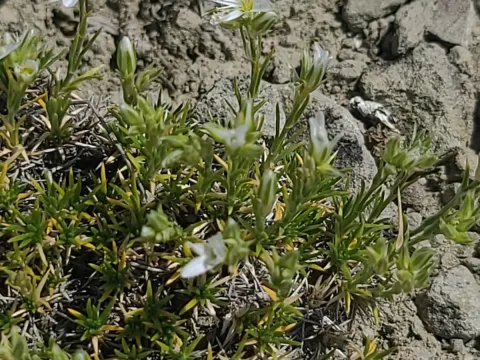
Hooker's sandwort
Arenaria hookeri
Hooker's sandwort (Arenaria hookeri) is a perennial herb belonging to the Caryophyllaceae family, native to the arid regions and prairies of North America. It is recognized for its dense, cushion-forming growth habit, making it a distinctive component of rocky landscapes and alpine-style gardens.
What the section contains
Hooker's sandwort
This species thrives in well-drained, sandy, or gravelly soils that offer excellent permeability. It is inherently adapted to survive in environments with poor nutrient content, where it can utilize its root system to extract moisture even in challenging, arid conditions throughout the growing season.
Exposure to full sunlight is a critical environmental requirement for Hooker's sandwort to maintain its compact morphology. If grown in shaded or overly damp environments, the stems tend to stretch, losing the aesthetic appeal of the plant's characteristic tight, ground-hugging form.
Agricultural management is relatively simple, requiring minimal intervention. Irrigation should be applied only during prolonged drought periods, and the use of fertilizers is generally discouraged as it can lead to succulent growth that is more susceptible to disease and winter damage.
For propagation, seeds should be sown in a well-draining medium. Ensuring that the crown of the plant remains dry is a vital aspect of long-term cultivation, which can be easily achieved by adding a layer of fine, coarse-textured mulch around the base of the plant to prevent soil contact.
The primary threats to the health of Arenaria hookeri include fungal diseases, specifically those affecting the roots and crown, which are almost exclusively caused by excessive soil moisture and poor drainage patterns.
In terms of pests, this plant may occasionally suffer from aphids that colonize the flower stalks, and it is occasionally susceptible to damage from slugs or snails during wet spells, which can compromise the integrity of the dense leaf clusters.