
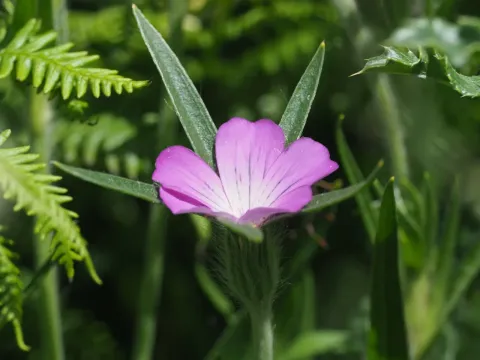
Flax cockle
Agrostemma linicola
Flax cockle (Agrostemma linicola) is an annual plant belonging to the Caryophyllaceae family. It is historically recognized as a specialized weed associated with cultivated flax crops, and its distribution is primarily confined to regions where flax has been traditionally farmed.
What the section contains
Flax cockle
The plant thrives in temperate climates, requiring soils that provide consistent moisture throughout the growing season. Its ecological niche is perfectly adapted to the flax cultivation environment, allowing it to grow in tandem with the primary crop without requiring additional nutrient inputs.
Morphologically, the plant features slender stems and linear leaves that allow it to blend seamlessly into a flax field. This structural similarity makes manual removal difficult, as the weed is often indistinguishable from the flax plants during the early vegetative stages.
Flax cockle has a relatively simple root system but possesses high physiological vigor. It focuses its energy on rapid height gain to compete for sunlight, which is a key requirement for its survival in dense, commercial-scale flax monocultures.
Agronomic management is heavily focused on seed purity. Because the seeds of Agrostemma linicola are remarkably similar in size and density to those of flax, cleaning harvested batches requires advanced equipment, making prevention through clean seed stock the primary focus.
The main economic threat posed by flax cockle is the contamination of flax seeds. The presence of these weed seeds in a harvest batch significantly degrades the product's grade, often necessitating expensive cleaning processes or resulting in price deductions.
Regarding diseases, the weed serves as an alternative host for several fungi common in flax fields. By maintaining a reservoir of infection, the weed facilitates the rapid spread of diseases such as rust or blight, especially during warm and humid weather conditions.
Pests that target flax, such as the flax flea beetle, can also feed on flax cockle. While the weed is hardy, infestation by these insects can reduce the vigor of the plant, though it rarely eradicates the infestation entirely without targeted control.
Crop rotation is considered the most effective long-term management strategy. By alternating flax with cereals or leguminous crops, farmers can disrupt the reproductive cycle of the weed, preventing it from producing and dispersing new seeds into the soil bank.
Herbicidal control remains a vital component of integrated weed management (IWM). Choosing the correct timing to spray is crucial; application should occur during the early development phase to ensure that the chemical effectively suppresses the weed before it can compete for nutrients.