
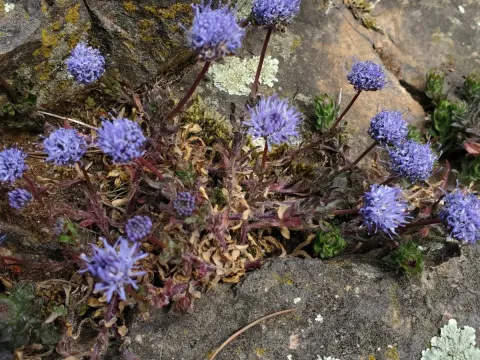
Jasione maritima
Jasione maritima
Jasione maritima, commonly known as a species of sheep's bit, belongs to the Campanulaceae family. Native to the coastal regions of Europe, this perennial herb is evolutionarily adapted to thrive in nutrient-poor, sandy environments and exposed coastal cliffs.
What the section contains
Jasione maritima
The plant is characterized by its compact, tufted foliage and striking, globular clusters of small, pale-blue to violet-blue flowers. Its growth habit is low-lying, making it an excellent candidate for ground cover in specific horticultural applications where height is not required.
In terms of agricultural requirements, this species demands exceptionally well-draining soil. It is perfectly suited for sandy, rocky, or gritty substrates where water cannot accumulate around the crown of the plant, as poor drainage is the primary cause of failure in cultivation.
Full sun is mandatory for Jasione maritima to maintain its compact form and vibrant floral production. It is highly drought-tolerant once established, requiring minimal irrigation except during extreme and prolonged dry spells in the early stages of growth.
Its primary use is ornamental, frequently utilized in xeriscaping, rock gardens, and crevices where it mimics its natural seaside habitat. It requires little to no fertilization, as high nutrient levels can actually lead to weak, elongated growth and reduced flower quality.
The most significant threat to Jasione maritima is root rot caused by stagnant water in the soil. To prevent fungal pathogens, growers must ensure that the planting site has excellent percolation and is not prone to flooding during dormant seasons.
Pests such as snails and slugs can occasionally target the succulent-like foliage, especially in spring. Maintaining a dry, gritty top-dressing around the plant base is a common cultural practice used to deter these pests and maintain general plant hygiene.