
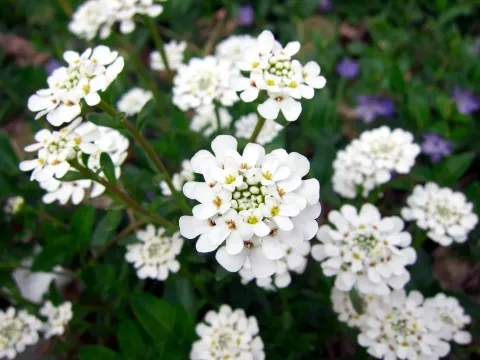
Iberis corifolia
Iberis corifolia
Sowing Iberis corifolia seeds directly into the open ground is best done in early spring, specifically in April or May, once the soil has warmed up. Fall sowing is also possible in late October, allowing for natural winter stratification of the seeds.
What the section contains
Iberis corifolia
For indoor propagation, seeds should be sown in seedling trays in March under good lighting conditions. Transplant the seedlings into their final location in late May, ensuring a spacing of 20–25 centimeters between plants to allow for healthy airflow.
The seeds should be sown at a shallow depth of 0.5 to 1 centimeter, as they require light to germinate effectively. Covering them with a thin layer of fine soil and maintaining consistent humidity is essential for successful germination.
Vegetative propagation via cuttings is highly effective and should be performed after the flowering period concludes. Rooted cuttings grow faster than seedlings and ensure that the plant retains its specific variety characteristics without variation.
Selecting the right site is crucial: the plant thrives in full sun and requires well-drained soil. Avoid areas where water tends to accumulate, as Iberis corifolia is sensitive to waterlogging, which can compromise its growth habit.
As a member of the Brassicaceae family, Iberis corifolia is a hardy perennial known for its compact, mat-forming growth habit. Originating from mountainous regions, it is naturally adapted to challenging environments and poor soil conditions.
The plant performs best in light, sandy or loamy soils with a neutral pH level. In heavy clay soils, it is necessary to incorporate sand or fine gravel to improve drainage and root aeration, which are critical for the plant's long-term health.
Iberis corifolia is remarkably cold-hardy, although in regions with harsh, snowless winters, young plants may benefit from protective covering. Mature plants are well-adapted to withstand significant temperature fluctuations typical of mountainous areas.
Watering should be managed with caution; the plant is drought-tolerant but suffers greatly from excessive moisture. Always water at the base of the plant during extended dry spells, keeping the flowers and foliage dry to prevent rot.
- Full sun exposure
- Excellent soil drainage
- Low to moderate fertilization
- Regular pruning after flowering
Clubroot is a significant threat to plants in the Brassicaceae family, including Iberis corifolia. Prevention focuses on crop rotation and ensuring that the soil does not stay overly damp, which favors the spread of soil-borne pathogens.
Powdery mildew may occur in areas with poor air circulation or high humidity. If white fungal spots appear on the leaves, remove the affected foliage and treat the remaining plant with an appropriate systemic fungicide.
Flea beetles are common pests that can quickly damage leaves during the spring growth phase. Monitoring and early intervention with suitable insecticides or organic deterrents are essential to protect the aesthetic appeal of the perennial.
Aphids can occasionally infest young shoots and flower buds. Controlling their population with soap-based sprays or biological predators is recommended to maintain plant vigor without the use of harsh chemical treatments.
Root rot is almost exclusively caused by improper irrigation or poor drainage. Maintaining a well-structured soil profile and following a "less is more" approach to watering will keep the root system healthy and resilient against fungal infections.