
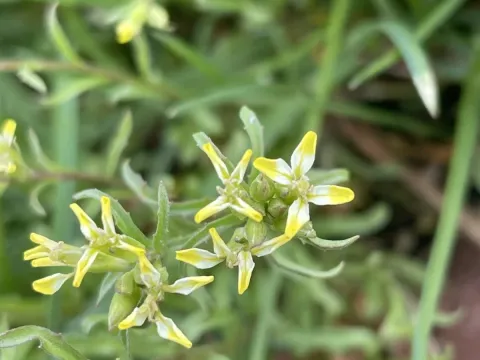
Spreading treacle-mustard
Erysimum repandum
Spreading treacle-mustard (Erysimum repandum) is a herbaceous plant that functions primarily as a winter or spring annual. It is a persistent weed that typically germinates during the cooler periods of the year, often establishing itself alongside winter cereals.
What the section contains
Spreading treacle-mustard
The seeds of this species are highly persistent in the soil seed bank. Germination usually peaks during the autumn season, allowing the weed to form a basal rosette before winter dormancy, which gives it a significant growth advantage come spring.
Effective management requires pre-seeding cultivation or stale seedbed techniques. By encouraging germination and then destroying the seedlings mechanically before planting the main crop, farmers can significantly reduce the weed population.
Spring-time control must be performed early, while the plants are still in the vegetative rosette stage. Once the plant enters the bolting phase, it becomes much more robust and resistant to standard agricultural treatments.
Maintaining a clean field surface during the early spring is crucial. Delaying the weeding process allows the plant to utilize stored soil moisture and nutrients that are intended for the crop, ultimately leading to yield loss.
Belonging to the Brassicaceae family, Erysimum repandum thrives in a variety of environments, particularly favoring well-drained, carbonate-rich, and loamy soils. It shows remarkable adaptability to different regional climate types.
The plant is known for its tolerance to drought, making it a particularly troublesome weed in arid and semi-arid agricultural regions. It struggles only in saturated, waterlogged soil conditions where drainage is poor.
Sunlight is a key requirement for the vigorous growth of spreading treacle-mustard. It performs best in open or poorly established crop stands where competition for light is low. Higher seeding rates can help shade out the weed seedlings.
Temperature range for germination is quite broad, often starting as low as 4 degrees Celsius. This early-season activity allows the plant to outcompete many other species in the initial weeks of the growing season.
Nutrient requirements are relatively modest, yet the plant is highly responsive to nitrogen. In high-input systems, it can exploit the available fertilizers to increase its biomass and reproductive capacity at the expense of the crop.
A primary concern with this species is its role as a reservoir for pests that target the Brassicaceae family, such as flea beetles. The presence of the weed in or near fields can lead to significant insect pressure on commercial oilseed crops.
The plant can harbor various fungal pathogens that also affect vegetable and oilseed crops. By remaining in the field margins or fallow areas, the weed acts as a continuous source of infection for new crop plantings.
Because it is a member of the same botanical family as many valuable crops (like canola or mustard), selective chemical control is often very difficult. Herbicides that effectively target the weed frequently harm the main crop as well.
High seed production is a major factor in its persistence. A single mature plant can release thousands of seeds, ensuring that the weed will return in subsequent years if not strictly managed during the flowering stage.
- Intense competition for moisture and soil nutrients.
- Harboring agricultural pests like flea beetles and aphids.
- Serving as a host for various cruciferous-specific diseases.
- Reducing the harvest purity due to seed contamination.
- High reproductive output complicating long-term eradication.