
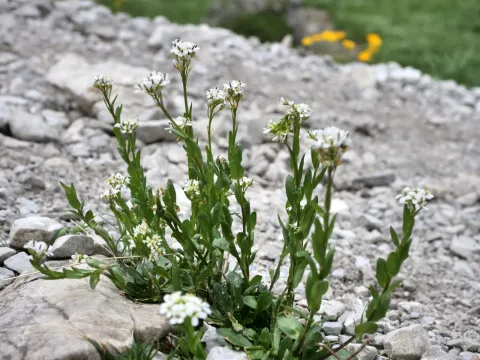
Soyer's rockcress
Arabis soyeri
Soyer's rockcress (Arabis soyeri) is a perennial herbaceous plant belonging to the Brassicaceae family. It is native to the mountainous regions of Europe, particularly the Alps and Pyrenees, where it thrives in rocky, high-altitude habitats.
What the section contains
Soyer's rockcress
The plant exhibits a rosette growth habit with evergreen or semi-evergreen foliage. The leaves are typically oblong and provide a dense ground cover, while the flowering stems arise in spring, bearing clusters of white flowers.
To cultivate Arabis soyeri successfully, well-drained, gritty, and low-fertility soils are essential. The plant is highly sensitive to root rot caused by stagnant moisture, making sharp drainage a primary requirement for its long-term survival.
This species requires full sun exposure to maintain its compact form and ensure productive flowering. In shaded conditions, the rosettes tend to become leggy and less resilient to environmental stresses.
As an alpine species, it is exceptionally hardy and capable of enduring freezing temperatures. It requires minimal intervention, as it is adapted to survive in poor, alkaline soils that might challenge less specialized garden varieties.
The agricultural usage of Arabis soyeri is strictly limited to ornamental horticulture. It is highly valued in rock garden design and xeriscaping due to its durability and aesthetic appeal during the spring season.
Propagation is typically managed through division or seed collection. Seed harvesting takes place once the siliques turn brown and begin to dry, requiring careful monitoring to prevent the pods from shattering in the field.