
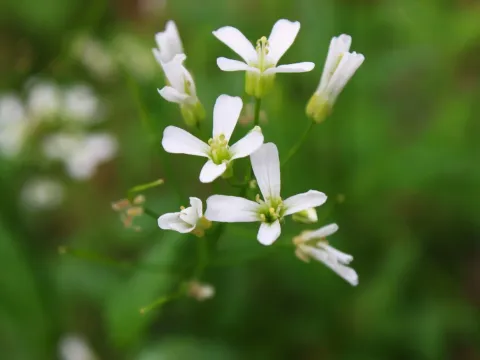
Spring cress
Cardamine bulbosa
Spring cress (Cardamine bulbosa) is a member of the Brassicaceae family. Seeds require a period of cold stratification to germinate effectively, which is why sowing in late autumn or early spring is recommended.
What the section contains
Spring cress
Seeds should be sown at a shallow depth of about 0.5 cm in a nutrient-rich, moist soil medium. Maintaining consistent surface moisture is critical during the initial germination phase.
Spacing plants about 20–25 cm apart allows for adequate airflow, which is essential to prevent fungal outbreaks. In garden settings, it can be grown in rows or as a groundcover in shaded areas.
Propagation can also be achieved by dividing the root bulbs. This vegetative method is highly reliable and helps in establishing a uniform crop in the following season.
Under optimal greenhouse conditions, seeds can be started indoors in late winter to give the plants a head start before transplanting into a protected outdoor environment.
This crop thrives in moist, cool conditions, mimicking its natural habitat near streams and wetlands. High organic matter content in the soil is essential for robust leaf development.
Spring cress prefers semi-shaded areas, as direct and intense sunlight can lead to rapid soil moisture loss and trigger the plant to bolt prematurely, ending its culinary season.
The ideal temperature range is between 15°C and 20°C. If temperatures spike significantly, the plant's growth slows down, and the leaves may become tough and lose their mild, peppery flavor.
Soil pH should remain near neutral or slightly acidic. If the soil is too clay-heavy, incorporating compost or leaf mold will improve drainage and overall fertility.
Consistent irrigation is the most important management factor. The plants should never experience total drying of the root zone, even during shorter periods of drought.
Crucifer flea beetles are the most common pest, often attacking young seedlings. Regular inspection and the use of row covers are recommended for organic management.
Clubroot can be a persistent threat if the soil remains waterlogged or is contaminated. Crop rotation with non-Brassicaceae plants is a key preventative strategy for long-term health.
Slugs and snails can consume large quantities of foliage rapidly, especially in humid and protected environments. Installing barriers is an effective cultural control method.
Powdery mildew may develop if there is insufficient spacing or poor air movement around the plant foliage. Thinning the crop ensures better ventilation.
Aphids occasionally colonize the flower stalks during the bolting phase. If an outbreak occurs, natural predators like ladybugs or insecticidal soaps are effective management tools.
Harvesting for fresh greens should occur just before the plant enters the bolting phase, as leaves become more bitter once the flower stalks begin to develop fully.
Use sharp scissors to harvest individual leaves from the outer parts of the rosette. This allows the central crown to continue producing new growth for consecutive harvests.
The small root bulbs can also be harvested for culinary use. They possess a pungent, horseradish-like quality that adds a unique depth to various prepared dishes.
Post-harvest handling is critical, as the leaves are highly perishable. Immediate cooling and storage in high humidity are necessary to maintain quality for the retail market.
If not sold immediately, the greens should be stored in refrigerated conditions at temperatures close to 1°C to slow down respiration and wilting processes.