
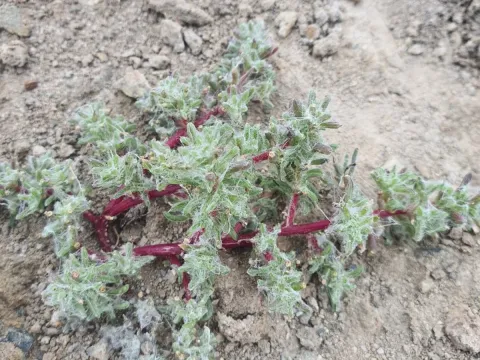
Halogeton arachnoideus
Halogeton arachnoideus
Halogeton arachnoideus is a specialized halophytic plant species belonging to the Amaranthaceae family. It is native to the arid and semi-arid regions of Central Asia, where it thrives in environments with extremely high soil salinity.
What the section contains
Halogeton arachnoideus
The plant exhibits remarkable physiological adaptations to harsh conditions. Its succulent leaves are designed to store moisture, while the characteristic arachnoid (web-like) pubescence helps in reducing transpiration, effectively managing the water balance under intense heat.
Regarding soil requirements, Halogeton arachnoideus is a strong halophyte. It prefers highly mineralized soils and serves as an important ecological indicator for salt-affected lands where traditional agricultural crops cannot survive.
Climate adaptation is a key feature of this species. It is well-suited to regions with low rainfall, high evaporation rates, and extreme temperature fluctuations, allowing it to occupy niches in desert and semi-desert ecosystems.
In terms of utilization, the plant plays a crucial role in preventing soil erosion in arid zones. It is frequently studied for its potential in phytoremediation projects aimed at stabilizing saline soils that are unsuitable for conventional farming.
Environmental threats to the species primarily involve habitat modification. Excessive freshwater irrigation of desert lands can lead to a reduction in the population density of Halogeton arachnoideus as it loses its competitive advantage.
Insect pests, specifically those adapted to high-salt diets, can cause localized damage to the foliage. These pests often follow the phenological stages of the plant, increasing activity during the active growth phase.
Fungal infections can occur when the plant is subjected to unusually prolonged periods of humidity. Such conditions disrupt the standard physiological processes and make the succulent tissues vulnerable to rot.
Overgrazing by livestock remains a significant threat. Although the plant is often avoided due to its high oxalate content, trampling by animals damages the delicate shoots and the structure of the soil crust surrounding the roots.
Land development and infrastructure expansion pose long-term risks to the survival of stable plant communities, especially in areas where these plants provide essential ground cover against desertification.