
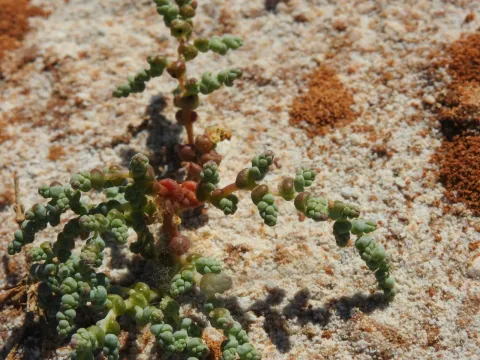
Halopeplis
Halopeplis
Halopeplis is a genus of annual succulent plants belonging to the Amaranthaceae family. These plants are true halophytes, specifically evolved to thrive in high-salinity environments such as salt marshes, salt pans, and arid saline depressions.
What the section contains

Halopeplis
Botanically, these plants exhibit distinct succulent stems and reduced leaves, which help minimize water loss in extreme desert conditions. Their ability to sequester salts in their vacuoles allows them to maintain osmotic balance despite the harsh soil environment.
Cultivation requirements involve highly specific saline soil conditions. They do not require traditional fertilization; rather, they rely on the natural mineral content of the substrate to perform their metabolic functions effectively.
Climate preferences for Halopeplis are centered on intense sunlight and high temperatures. They are well-adapted to wide diurnal temperature variations, which are characteristic of their native habitats in Eurasia and North Africa.
Regarding practical use, the genus is increasingly viewed as a valuable resource for phytoremediation. By covering barren, salty ground with vegetation, they prevent wind erosion and gradually improve soil conditions for other specialized desert species.
Pathogen pressure on Halopeplis is negligible. The hyper-saline nature of their tissue acts as a natural deterrent against most common plant diseases, providing them with a high level of innate protection.
Waterlogging remains the primary environmental threat. As plants adapted to arid regions, their root systems are highly sensitive to soil compaction and prolonged water stagnation, which can cause rapid decay.
Insects rarely cause significant damage. The high saline content of the leaves makes them unpalatable to most herbivores, meaning that pest management is not a standard requirement for these populations.
Human activities, particularly uncontrolled off-road vehicle use or overgrazing, pose the most significant risk to these delicate ecosystems. Physical disturbance can destroy entire colonies before they have the chance to disperse seeds.
Climate change and altered drainage patterns can also threaten populations by changing the salinity level of their habitats. If the soil becomes too sweet (less salty), Halopeplis may be outcompeted by more aggressive vegetation.