
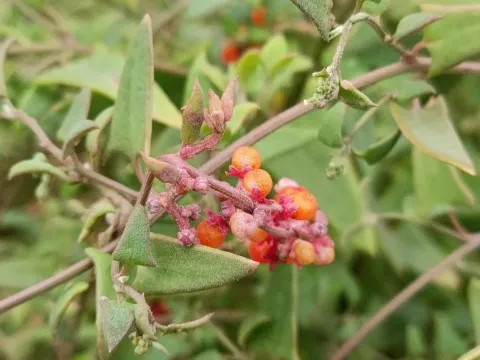
Chenopodium nutans
Chenopodium nutans
Sowing of Chenopodium nutans is carried out in the spring, once the soil at seed depth warms up to 8–10 degrees Celsius. The optimal timing usually falls in the second half of April or early May, depending on specific regional climatic conditions.
What the section contains
Chenopodium nutans
To ensure high-quality germination, it is recommended to use seed drills with precise depth control, as the crop's seeds are relatively small. Planting depth should be maintained between 1 and 2 centimeters, ensuring good soil-to-seed contact.
Seeding rates vary depending on the planting method and the intended use of the crop. Row planting with spacing of 30–45 centimeters is commonly used, as it facilitates subsequent crop maintenance and mechanical weed control.
Prior to sowing, it is crucial to perform effective pre-sowing cultivation to create a fine-textured soil structure. This promotes uniform seedling emergence and consistent growth rates across the field.
After planting, the field should ideally be rolled with light rollers to improve capillary moisture movement. This practice is particularly critical during periods of low rainfall in the early vegetative stage of the plant.
Chenopodium nutans, a member of the Amaranthaceae family, is a resilient crop capable of adapting to diverse growing environments. It demonstrates high tolerance to saline soils, making it a promising candidate for cultivation on degraded lands.
The plant prefers well-lit areas, as it is a light-demanding crop. Shade leads to stem elongation and a significant decrease in biomass, so planting in open, sunny fields is an essential condition for success.
The crop does not have strict requirements regarding soil mechanical composition, although it performs best in light sandy loam or loam substrates with good aeration. Waterlogging is highly undesirable as it can trigger root rot.
The optimal soil pH range for cultivating this species is 6.0–7.5. On acidic soils, liming is required, which positively impacts both grain yield and green mass production.
While the plant is known for its drought resistance, moderate moisture during critical growth stages, such as budding and flowering, is required to achieve maximum yields. With adequate nutrient availability, the plant can produce substantial vegetative growth.
The yield potential of Chenopodium nutans depends on the intensity of the agronomic practices and specific variety traits. In favorable years, when all management protocols are followed, grain yields can reach 1.5–2 tonnes per hectare.
The green mass is also of significant value, used primarily as a high-protein feed for livestock. When harvested early, the biomass yield can reach 20–30 tonnes per hectare.
The final yield is strongly influenced by plant density, which should be maintained between 300,000 and 500,000 plants per hectare. Sparse stands fail to maximize production, while overly dense populations lead to intraspecific competition.
To enhance yields, moderate applications of nitrogen fertilizers during the active growth phase are recommended. Phosphorus and potassium fertilizers should be applied during primary soil cultivation to ensure balanced plant nutrition.
Regular field monitoring allows for timely adjustments to management practices, directly influencing the achievement of yield targets. Effective weed control during the early vegetative stage remains a vital yield-protecting factor.
The main pests of this crop include various species of flea beetles and weevils that damage young seedlings. To control these, contact and systemic insecticides are applied during the early developmental phases of the plant.
Regarding diseases, the greatest risks are fungal infections such as powdery mildew and various leaf spot diseases, which thrive in high-humidity conditions. Prevention includes crop rotation and the destruction of post-harvest residues.
Aphids can colonize fields, sucking sap from leaves and young shoots. This weakens the plants and facilitates the spread of viral diseases, necessitating protective treatments once economic thresholds are reached.
Root rot occurs if irrigation regimes are violated or under waterlogged soil conditions. Preventing water stagnation and maintaining good drainage are the best measures for mitigating these pathologies in agricultural settings.
- Strict adherence to crop rotation.
- Spatial isolation from related wild species.
- Utilization of certified, high-quality seed.
- Application of balanced soil nutrition.
Harvesting Chenopodium nutans is performed at the stage of full seed maturity, characterized by seed darkening and susceptibility to easy shattering. It is important to avoid keeping the crop on the field too long to minimize harvest losses.
Direct combining is the preferred method when the crop matures uniformly. Modern grain combines are highly efficient at threshing this crop, provided that drum speed and clearance settings are correctly adjusted.
In cases of uneven maturation, a two-stage harvest method is recommended. First, the plants are cut into windrows to dry for several days, after which they are collected and threshed by the combine.
Post-threshing, the grain requires mandatory cleaning and drying to a moisture content of 12–14 percent. This is essential for long-term storage without the risk of mold development or product spoilage.
The harvested seeds can be used for both food purposes and as concentrated feed in poultry and livestock farming. The high nutritional profile of the seeds makes them increasingly sought after in the market.