
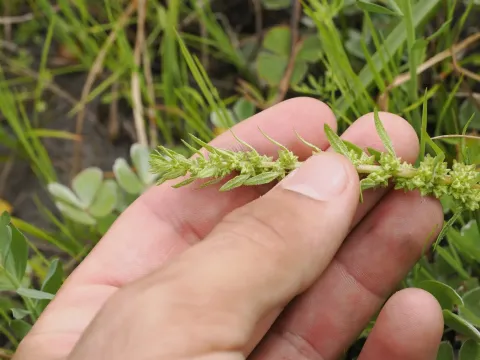
Chenopodium atriplicinum
Chenopodium atriplicinum
Sowing of Chenopodium atriplicinum is carried out in the spring when the soil temperature reaches 10-12 degrees Celsius. The optimal time for field work is mid-April or early May.
What the section contains
Chenopodium atriplicinum
The seeding depth should not exceed 1-2 centimeters, as the seeds of this crop are relatively small and require good contact with a moist substrate.
The seeding rate varies depending on the sowing method; usually, row sowing with 45-60 centimeters between rows is used to ensure quality crop management.
After sowing, it is recommended to roll the soil to improve capillary moisture rise and ensure uniform seedling emergence.
It is important to avoid overcrowding the crops, as this leads to competition for light and nutrients, ultimately reducing the overall yield.
The crop belongs to the Amaranthaceae family and is characterized by high adaptability to various growing conditions and soil types.
The plant demonstrates significant drought tolerance, allowing it to be cultivated in regions with insufficient moisture during the summer months.
Chenopodium atriplicinum prefers well-drained loamy or sandy loam soils with a neutral or slightly alkaline pH level.
Sufficient sunlight is necessary for intensive growth, as the plant is photophilous and does not tolerate heavy shading well.
The optimal temperature for vegetation ranges from 20-25 degrees, although the crop can withstand short-term temperature fluctuations without significant damage.
The main threats to young crops are pests typical for the Amaranthaceae family, such as flea beetles or aphids.
Under high humidity conditions, plants may be affected by powdery mildew, which requires careful density control and field ventilation.
Root rot is one of the most dangerous diseases, which often arises due to waterlogged soil and poor aeration of the root system.
Weeds pose a significant challenge during the early stages of development, making timely inter-row cultivation an essential practice.
To prevent the spread of diseases, it is important to follow crop rotation practices and avoid replanting on the same field for at least 3-4 years.
Harvesting is performed when the plants reach full maturity, characterized by hard seeds and yellowing of the vegetative biomass.
A key indicator of harvest readiness is a seed moisture content drop to 14-16 percent, which prevents spoilage during storage.
Harvesting is carried out by direct combining, requiring correct threshing machine adjustments to minimize seed breakage.
After threshing, the seeds must be cleaned of plant debris and subsequently dried in well-ventilated facilities.
Properly dried harvests can be stored for long periods without losing sowing or nutritional qualities, maintaining a stable chemical composition.