
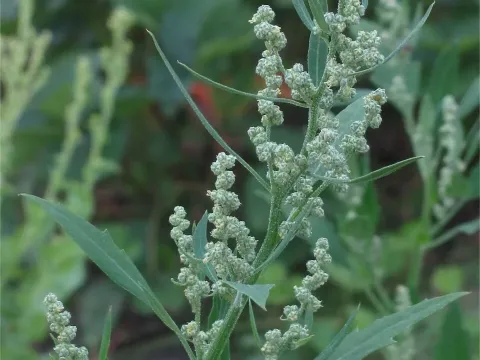
Goat's-foot goosefoot
Chenopodium hircinum
Chenopodium hircinum, commonly known as goat's-foot goosefoot, is an annual herbaceous plant in the Amaranthaceae family that serves as a valuable forage and potential pseudocereal crop. Sowing typically occurs in late spring when the soil temperature consistently reaches 10-12 degrees Celsius.
What the section contains
Goat's-foot goosefoot
The seeds are sown at a shallow depth of 1-2 centimeters to facilitate rapid germination. Ensuring proper soil-to-seed contact is critical for establishing a uniform crop stand during the initial growth phases.
Standard row sowing techniques are employed, with spacing between 30 and 45 centimeters. This design optimizes the plant's ability to access sunlight while allowing for mechanical weed control between rows.
Density management is essential; depending on the intended use—grain production versus biomass—the seeding rate is adjusted to achieve optimal competition and yield potential.
High-quality, cleaned seeds are recommended to ensure that no foreign material or contaminants are introduced during the sowing process, maintaining field purity.
This crop displays significant ecological plasticity, meaning it can thrive in a variety of soil types ranging from loamy sands to heavy silty loams. It prefers soils with a neutral to slightly alkaline pH.
While the plant shows notable drought tolerance, peak productivity is achieved when adequate soil moisture is maintained throughout the vegetative growth period.
Chenopodium hircinum is highly light-demanding. Exposure to full sun is necessary for vigorous growth and the development of high-quality seeds, while shading can lead to significant yield drops.
Nutrient requirements, particularly for nitrogen and potassium, are moderate to high during the early stages of development. Split applications of fertilizer can help improve biomass accumulation.
The species is well-suited to temperate and subtropical climates, demonstrating resilience against temporary unfavorable weather conditions often found in marginal agricultural areas.
Yield parameters for goat's-foot goosefoot vary based on soil fertility and the efficacy of agronomic practices. Under ideal conditions, the crop produces significant biomass suitable for livestock feed.
Seed yields typically reach 1.5–2 metric tons per hectare. The grain is noted for its nutritional density, often compared favorably to other pseudocereals in terms of protein content.
Effective management of inter-row cultivation significantly enhances final productivity by reducing competitive stress from weeds during the plant's slow early development phase.
Biomass production is maximized when the crop is harvested at the onset of flowering, capturing the plant at its nutritional peak for feed purposes.
Data suggests that consistent moisture and strategic mineral fertilization contribute to stabilizing yield outcomes even across fluctuating seasonal conditions.
Like many Chenopodium species, this plant can be prone to fungal infections, particularly downy mildew and leaf spots, which may flourish under high humidity or poor field drainage.
Insect pests, including aphids and various curculionid beetles, are common threats that can damage young vegetative tissues and reduce seed set if left unmanaged.
Integrated pest management (IPM) is strongly advised, emphasizing crop rotation and avoiding overly dense plantings to ensure better air circulation throughout the crop canopy.
Biological controls and preventative agronomic measures, such as removing crop residues after harvest, are effective ways to mitigate the build-up of recurring pathogens.
- Monitoring fields for early signs of fungal lesions.
- Applying targeted biological pest control when necessary.
- Maintaining optimal row spacing to prevent disease spread.
Harvesting for grain occurs upon full maturity when the seeds are hard and the panicles have dried sufficiently. Seed moisture content should be monitored to prevent spoilage.
When the target is forage, harvest should be conducted during the budding or early flowering stage, as this timing ensures the highest protein concentration and digestibility.
Grain harvesting requires careful combine harvester calibration. Due to the small size of the seeds, fan settings must be adjusted to minimize loss during the threshing process.
Post-harvest handling is critical; seeds must be cleaned and dried immediately to achieve a moisture content suitable for safe long-term storage, preventing heating and fungal issues.
Timely harvest is essential, as the seeds of many goosefoot species are prone to shattering if left in the field past their peak maturity point.