
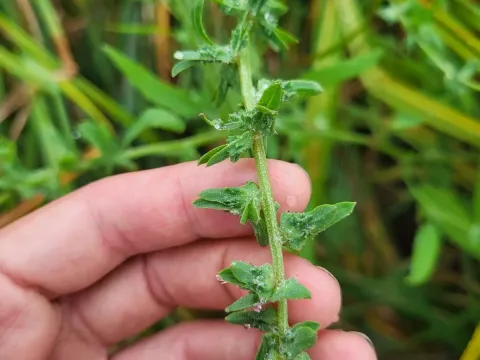
Gmelin's saltbush
Atriplex gmelinii
Gmelin's saltbush belongs to the Amaranthaceae family and is recognized for its remarkable adaptation to specific saline environments. The optimal time for sowing is early spring when the soil temperature consistently reaches 8–10 degrees Celsius.
What the section contains
Gmelin's saltbush
The seeds possess high germination energy, allowing for rapid emergence under variable spring weather conditions. The recommended seeding depth is 1–2 centimeters, ensuring the seeds have adequate moisture contact for successful establishment.
When cultivating on saline lands, it is essential to maintain an appropriate planting density to reduce intraspecific competition. This management practice enables each plant to develop a robust root system and reach its full biomass potential.
Planting equipment must be calibrated for small seeds to ensure uniform distribution across the field. Post-sowing soil compaction is advised to enhance capillary water movement and ensure optimal contact between the soil and the seeds.
Adjusting sowing dates is critical in regions with dry summers; early planting is preferred to capture winter moisture. This ensures that the crop develops enough vegetative mass before the heat of midsummer sets in.
The primary requirement for growing Gmelin's saltbush is the presence of saline soil, as it is an obligate halophyte. The plant effectively utilizes mineral salts present in the soil solution for its physiological processes.
This crop is highly drought-tolerant, capable of thriving with limited irrigation in arid or semi-arid conditions. Intense sunlight is beneficial for its photosynthetic activity and the accumulation of biomass and nutrients in its foliage.
Gmelin's saltbush prefers loamy or sandy-loam soils that offer good aeration and nutrient-holding capacity. Saline soil horizons are not a hindrance but a natural environment that supports high-quality forage production.
Moderate temperatures are ideal for vegetative growth, though the plant exhibits significant plasticity to temperature fluctuations. Waterlogging on heavy soils should be avoided as it can cause root system suppression and health decline.
The ideal soil pH for this species ranges from 7.0 to 8.5. It thrives in alkaline and neutral soil types; acidic soils are generally unsuitable and require liming if agriculture must be conducted on such fields.
The yield potential of Gmelin's saltbush ranges from 10 to 25 tonnes of green mass per hectare, depending on soil salinity and nitrogen availability. Targeted fertilization can enhance these yields significantly.
The main agricultural use of this crop is for silage and hay production, providing a valuable protein source for ruminants. Livestock readily consume the forage when it is harvested at the correct physiological stage.
The nutritional profile of the plant makes it an excellent supplement to animal diets, especially in areas where traditional forage is scarce. Proper dietary formulation ensures that mineral salt intake remains within safe limits for livestock.
To maximize yields, harvesting should occur during the budding phase, before active lignification of the stems. Timely harvesting improves feed quality and prevents the plant from becoming too fibrous for livestock consumption.
Under favorable moisture conditions, two cuttings per season may be possible, which increases total forage output. This multi-cut strategy is essential for maximizing the productivity of land in saline-affected areas.
Gmelin's saltbush displays natural resistance to most pests, primarily due to the high salt concentration in its tissues. This chemical defense mechanism effectively deters many common insects and potential plant pathogens.
Young seedlings may be susceptible to flea beetles in the early stages, requiring monitoring during the first weeks of growth. Usually, cultural practices are sufficient to maintain healthy crop development without chemical intervention.
Fungal diseases, including powdery mildew, are rarely recorded and do not pose a significant threat to industrial-scale fields. This allows for low-input production and minimizes the environmental impact of chemical usage.
Aphid outbreaks on young shoots are occasionally seen in years with anomalous heat. However, insecticides are only needed in extreme cases, as natural regulation is often sufficient to maintain the crop health.
Weed competition is generally low because of the crop's vigorous growth and ability to form a dense canopy. Regular field scouting is advised to detect potential problems early in the season, ensuring optimal field management.
Harvesting technology involves the use of forage harvesters for silage production or mowers for haymaking. It is important to mow during dry periods to ensure proper drying and long-term storage quality of the forage.
Hay prepared from Gmelin's saltbush must be stored in protected areas to prevent moisture damage. Its high mineral content makes it an excellent winter supplement for agricultural animals in arid regions.
Silage production should follow standard technological norms, ensuring proper compaction in silos to preserve vitamins and protein content. This method ensures high energetic value of the feed throughout the winter period.
When harvesting for seed, it is crucial to avoid over-ripening to prevent loss from shattering. Combines should be carefully adjusted to account for the small size and fragility of the seed capsules.
Post-harvest seed processing includes cleaning and drying to reach a moisture level of 12–14 percent. High-quality seed lots can maintain excellent germination rates for several years under proper storage conditions.