
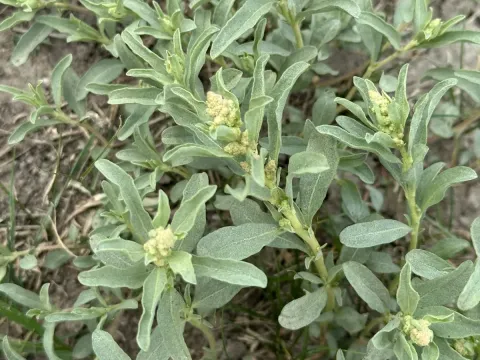
Gardner's saltbush
Atriplex gardneri
Gardner's saltbush (Atriplex gardneri) is a perennial subshrub belonging to the Amaranthaceae family. In agricultural or experimental settings, propagation is primarily achieved through seeds, which require careful handling due to their natural adaptation to specific environmental triggers for germination.
What the section contains
Gardner's saltbush
The optimal sowing time is in the early spring once the soil temperature is sufficient to support initial seed development. Since the seeds are small, they should be planted at a shallow depth to ensure they receive enough oxygen and light exposure to initiate the germination process successfully.
Uniform soil moisture is crucial during the initial stages of seedling establishment. Despite the high drought tolerance of mature plants, seedlings remain vulnerable to moisture fluctuations and extreme heat during their first few weeks of life.
When planning a cultivation plot, it is essential to consider the final size of the plant, which typically grows into a dense mound. A row spacing of at least 60 to 70 centimeters is recommended to allow for proper airflow and to facilitate mechanical weeding if necessary.
Post-sowing management focuses on keeping the area free from aggressive weeds. Since Gardner's saltbush develops relatively slowly at the start, competitive weeds can easily choke out young seedlings, significantly reducing the success rate of the planting.
As a true halophyte, Gardner's saltbush thrives in soils with high salt concentrations, including those rich in selenium. It is remarkably capable of flourishing in alkaline, heavy clay, or silty soils where other crops typically fail, making it a candidate for soil reclamation projects.
Full sun exposure is a non-negotiable requirement for this species. Any form of shading or competition from taller vegetation will result in weak, elongated stems and a drastic reduction in biomass production, hindering the plant's overall vigor.
The plant demonstrates exceptional resilience to temperature extremes, adapting to both hot, dry summers and cold winters. Its physiological ability to manage transpiration allows it to maintain cell turgor even during periods of intense moisture deficit.
Proper soil drainage is vital to prevent root rot. While the plant loves saline conditions, it cannot tolerate waterlogged soils. Sites with good surface drainage and low water tables are the most suitable for long-term production and health of the crop.
In terms of fertilization, the plant is relatively undemanding, having evolved in nutrient-poor ecosystems. While it responds to some inputs, over-fertilization with nitrogen can sometimes lead to excessive vegetative growth at the expense of root system depth and stress tolerance.
Root rot, primarily caused by fungal pathogens such as Fusarium, remains the most significant threat to Gardner's saltbush, especially in poorly drained soil conditions. Preventing soil saturation is the primary defense strategy against these diseases.
Insect pests, particularly grasshoppers, can cause severe defoliation during outbreak years. Regular field monitoring is necessary to identify early signs of feeding damage, as large populations can consume significant portions of the standing biomass.
Powdery mildew may occur if atmospheric humidity levels remain high for extended periods, particularly in dense stands. This disease manifests as a dusty white covering on foliage, reducing the photosynthetic capacity of the plant and weakening it over time.
Sucking insects, such as aphids, may colonize young, succulent shoots during the spring growth phase. While they are usually a minor issue, they can vector viruses or weaken the plant's defense mechanisms against secondary infections.
Effective management includes integrated pest control strategies: maintaining proper row spacing to ensure good air circulation, rotating crops where feasible, and removing alternative host plants from the borders of the cultivation area.