

Reference · Crops
Chenopodium
Chenopodium L.
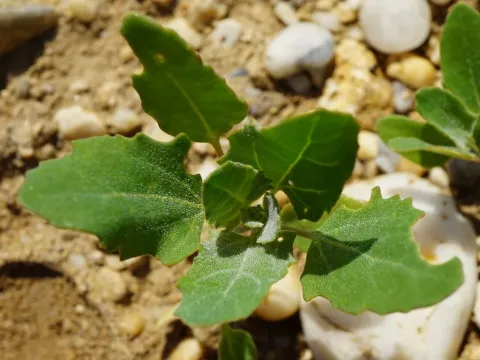
Sowing of Chenopodium species is best performed in early spring when the soil has reached a stable temperature conducive to germination.
10
items
What the section contains
 Quinoa
Chenopodium quinoa Willd.
3 products
Quinoa
Chenopodium quinoa Willd.
3 products
 Berlandier's goosefoot
Chenopodium berlandieri Moq.
Berlandier's goosefoot
Chenopodium berlandieri Moq.
 Cañihua
Chenopodium pallidicaule Aellen
Cañihua
Chenopodium pallidicaule Aellen
 Chenopodium spinescens
 (R. Br.) S. Fuentes & Borsch
Chenopodium spinescens
Chenopodium spinescens (R. Br.) S. Fuentes & Borsch
 Epazote
Chenopodium ambrosioides L.
Epazote
Chenopodium ambrosioides L.
 Fat hen
Chenopodium album L.
Fat hen
Chenopodium album L.
 Fig-leaved goosefoot
Chenopodium ficifolium Sm.
Fig-leaved goosefoot
Chenopodium ficifolium Sm.
 Maple-leaved goosefoot
Chenopodium hybridum L.
Maple-leaved goosefoot
Chenopodium hybridum L.
 Nettle-leaved goosefoot
Chenopodium murale L.
Nettle-leaved goosefoot
Chenopodium murale L.
 Strawberry blite
Chenopodium baccatum Labill.
Strawberry blite
Chenopodium baccatum Labill.
Marketplace
Products in this section · 3


Chenopodium
The seeds possess strong vitality, ensuring consistent emergence even under varying environmental conditions typical of the early growing season.
Appropriate seeding depth is critical; it should be adjusted based on soil texture to promote uniform seedling development.
Establishing an optimal plant density is essential for maximizing yield and managing the competitive balance within the field.
Ensuring adequate contact between the seeds and moist soil particles is a key agronomic practice for high-quality stand establishment.
Chenopodium belongs to the Amaranthaceae family and is known for its remarkable ability to thrive in diverse ecological conditions.
The crop requires full sun exposure to optimize photosynthetic activity and biomass production throughout the growth cycle.
Soil fertility is important; while adaptable, the plant performs best in well-drained, nutrient-rich soils with a neutral pH balance.
Efficient moisture management is particularly important during the vegetative stage to support rapid development of the root system.
Its resilience to various stressors makes it a reliable choice for sustainable agricultural systems in different climate zones.
Crop productivity is heavily influenced by the adoption of good agricultural practices, including balanced fertilization and timely cultivation.
When grown for foliage, biomass output is significantly boosted by consistent access to nitrogen during the rapid growth phase.
Seed yield varies depending on the specific cultivar and the effectiveness of management strategies in mitigating environmental pressures.
Yield stability is improved through the implementation of controlled harvest timings to maximize the nutritional value of the final product.
Ongoing research into optimal input levels continues to improve the commercial viability of various species within the genus.
Common fungal diseases such as powdery mildew can impact the health of the crop, especially in areas with poor air circulation.
Insect pests, including aphids and various beetle species, can cause significant damage to young plants if left uncontrolled.
Integrated pest management strategies are recommended, focusing on early detection and the use of environmentally friendly control methods.
Crop rotation remains a fundamental practice to disrupt the life cycles of soil-borne pathogens and reduce pest pressure naturally.
Regular field scouting allows farmers to identify threats early and implement precise interventions before economic damage occurs.
Harvesting for nutritional leaf production is most effective before the plant enters the flowering phase to ensure high nutrient content.
Seed harvesting should be timed to coincide with full physiological maturity to prevent seed loss from premature shattering.
Modern harvesting machinery must be calibrated correctly to efficiently thresh the crop while maintaining the integrity of the seeds.
Post-harvest handling requires immediate cleaning and drying to reduce moisture levels, which is crucial for stable, long-term storage.
Proper storage conditions, including moisture control and ventilation, are essential to preserve the quality of the harvested crop.