
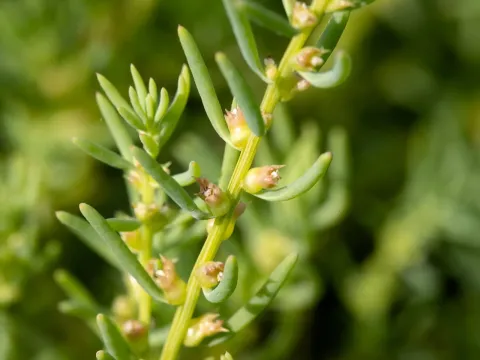
Bassia echinopsila
Bassia echinopsila
Bassia echinopsila is primarily propagated by seeds, which require specific conditions for germination. Sowing typically occurs in early spring when the soil temperature consistently reaches at least 10–12 degrees Celsius.
What the section contains
Bassia echinopsila
The seeds are small and should be sown at a shallow depth of approximately 1 to 2 centimeters. Ensuring proper soil-to-seed contact through rolling is essential for successful establishment, particularly in arid field environments.
Modern agricultural practices suggest using precision seeders to optimize plant spacing. This helps to reduce competition between plants for limited soil moisture and improves the overall uniformity of the crop stand.
While the plant is hardy, early establishment before the onset of extreme summer heat is crucial for reaching its full biomass potential. Delaying the sowing date often results in stunted growth and lower yields.
In extensive production systems, seed rates must be adjusted based on soil quality and moisture availability. Lower densities are recommended for marginal or extremely dry soils to ensure each plant can develop its root system fully.
This member of the Amaranthaceae family is highly adapted to arid and semi-arid climates. It is recognized for its exceptional resilience in environments where other traditional crops fail to thrive.
The species prefers light-textured, sandy, or loamy soils. It displays significant salt tolerance, making it an excellent candidate for the reclamation of saline lands that are otherwise considered unsuitable for conventional agriculture.
Abundant sunlight is a primary requirement for the plant's development. It does not tolerate shading, and even minor overcrowding within the field can negatively impact its growth rate and morphological development.
Water requirements are relatively low compared to traditional cereal or forage crops. The plant’s deep and extensive root system allows it to extract moisture from deep soil layers, providing survival during prolonged droughts.
Regarding soil fertility, while it is adapted to nutrient-poor soils, the application of nitrogenous fertilizers can significantly increase the production of vegetative biomass if water availability is not a limiting factor.
Bassia echinopsila generally exhibits high resistance to common pathogens. However, agricultural environments can present challenges under specific climatic conditions that favor the proliferation of pests.
Fungal issues such as root rot can occur if soil moisture levels remain excessively high for extended periods, especially in poorly drained areas. Proper land leveling and drainage are preventive measures.
Aphid infestations are the most common pest challenge. These insects congregate on tender shoot tips, extracting plant sap and potentially transmitting viruses, which can lead to reduced plant vigor.
Root-feeding larvae can pose a threat to younger plants, particularly in seasons with erratic rainfall. Monitoring the field during the seedling stage is vital for detecting these pests early.
Integrated pest management, including crop rotation and the control of host weeds in field margins, remains the most effective strategy for maintaining crop health and productivity.