
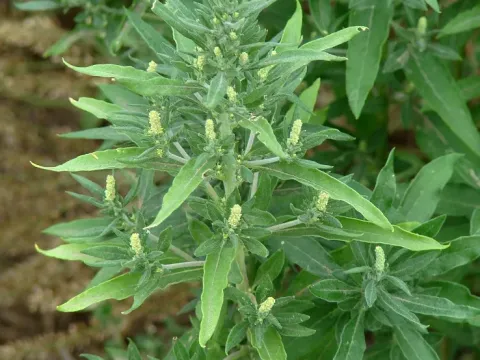
Axyris
Axyris
Axyris is an annual herbaceous plant that typically begins its growth cycle in early spring. Its seeds are known for their high germination capacity, allowing them to establish quickly when soil temperatures rise.
What the section contains

Axyris
The optimal germination period usually occurs from late April to May. The plant's lifecycle is well-adapted to the growing season of common cereal crops, making it a significant competitor in agricultural fields.
The emergence of seedlings is often staggered, which poses a challenge for agricultural management. Germination is strongly influenced by soil moisture and the depth of seed burial within the seedbed.
Shallow burial (up to 3 cm) promotes rapid emergence, while seeds buried deeper may remain dormant until subsequent tillage operations bring them closer to the soil surface.
Once established, the seedlings demonstrate vigorous growth, quickly developing a root system that allows them to tap into soil resources effectively before competitive crops close the canopy.
Axyris is recognized for its high ecological plasticity, enabling it to thrive in diverse environments ranging from arid steppes to well-cultivated agricultural fields.
It prefers sunny, open areas and is highly resistant to drought conditions. This adaptability allows the plant to persist in regions where other species might struggle with water scarcity.
While capable of growing on various soil types, including saline and sandy soils, Axyris typically performs best in nutrient-rich conditions, often appearing in high densities on fertilized plots.
The plant demonstrates remarkable tolerance to extreme temperature fluctuations, consistent with its wide distribution across continental climate zones.
Effective management requires understanding that Axyris can optimize its development even in low-density conditions, quickly producing branching stems that cover significant ground area.
Axyris is susceptible to various fungal pathogens typical of the Amaranthaceae family, including powdery mildew and several types of rust fungi that affect foliage.
Leaf-eating insects are common threats during the peak vegetative stage, potentially reducing the photosynthetic capability of the plant in cases of heavy infestation.
Soil-borne pests and nematodes may affect the root system, though the plant's robust nature often allows it to compensate for moderate damage and continue its reproductive cycle.
Control strategies in professional agronomy often combine mechanical cultivation with the strategic application of herbicides tailored to broad-leaved weed species.
- Mechanical cultivation before the flowering phase
- Strategic application of selective herbicides
- Crop rotation to reduce the seed bank in the soil