
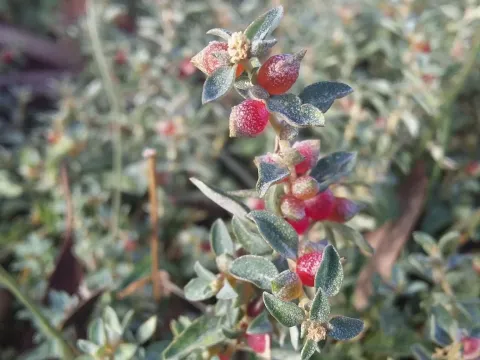
Atriplex standleyanus
Atriplex standleyanus
Atriplex standleyanus is a warm-season crop that requires stable, mild to warm temperatures for germination. Planting should be initiated only after the danger of late spring frosts has passed and the soil has sufficiently warmed up to promote rapid emergence.
What the section contains
Atriplex standleyanus
The seeds are relatively small and should be sown at a shallow depth of approximately 1 to 2 centimeters. Ensuring good seed-to-soil contact is essential for success, which can be achieved through light rolling of the field surface immediately following the sowing operation.
Row spacing should be carefully managed to allow for efficient weed control. Spacing between 45 and 60 centimeters is generally recommended to provide enough space for the plants to spread while maintaining optimal density for biomass production.
In arid regions, it is advisable to time the sowing with predictable rainfall events to provide the necessary moisture for early root establishment. If rain is scarce, localized irrigation may be required to guarantee a uniform plant population across the entire field.
Managing the sowing density is crucial for obtaining high-quality foliage. Too high a density can lead to nutrient competition and stunted growth, whereas too low a density may result in excessive weed pressure between the rows during the early stages of development.
This species is highly regarded as a halophyte, meaning it is exceptionally tolerant of saline soils. This characteristic makes it a valuable candidate for reclaiming or utilizing degraded lands where other common crops would fail due to excessive soil salinity.
Light intensity is a critical factor for the growth of Atriplex standleyanus. It thrives in full sun and shows poor development in shaded environments, often becoming spindly and losing its vigor if it does not receive sufficient direct sunlight throughout the day.
The crop is highly adapted to drought conditions and can withstand prolonged dry spells that would be fatal to less resilient species. It possesses a deep root system that efficiently extracts water from lower soil profiles, making it ideal for semi-arid agriculture.
While the plant does not require high levels of soil fertility, it responds positively to controlled nutrient inputs, especially nitrogen, which helps in maximizing the leafy biomass. It is highly adaptable to various soil types, ranging from sandy loam to heavier clays.
Temperature management is generally straightforward as the plant is evolved to endure high heat. Extreme cold can inhibit growth, but the species is well-suited to the thermal conditions found in hot, continental climates during the primary growing season.
Insects such as leaf-eating beetles and weevils are among the primary pests that can impact the development of the crop. These pests typically attack during the early vegetative stages, causing localized leaf damage that can weaken young plants if left unchecked.
Fungal diseases, particularly powdery mildew, may become a threat if the planting density is too high or if the canopy remains humid for extended periods. Proper spacing and ensuring good airflow within the canopy are effective preventative measures against such outbreaks.
Root rot can be a significant issue in poorly drained soils. Excess moisture creates an environment favorable for pathogens, leading to the rapid decay of the root system and ultimately resulting in the wilting and death of the plant from the base upwards.
Aphid populations can occasionally spike, especially during periods of dry, hot weather. While the plant is resilient, heavy aphid infestations can cause leaf curling and reduce the overall nutritional quality of the forage being produced for animal consumption.
Integrated Pest Management (IPM) strategies are highly recommended for this crop to balance productivity with ecological safety. Monitoring for pest activity and prioritizing cultural controls like crop rotation and balanced irrigation will minimize the reliance on chemical pesticides.