
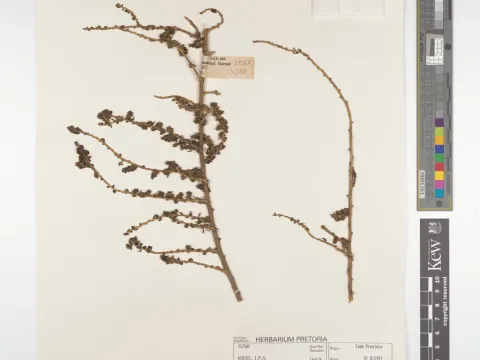
Bassia salsoloides
Bassia salsoloides
Bassia salsoloides is an annual herbaceous plant belonging to the Amaranthaceae family, known for its remarkable adaptation to extreme arid and saline environmental conditions.
What the section contains
Bassia salsoloides
The optimal sowing period occurs in early spring, utilizing the soil moisture accumulated during the winter season to ensure successful germination in challenging semi-desert habitats.
Seeds should be sown at a shallow depth, as the small size of the seeds requires a precise balance between moisture availability and proximity to the surface for effective emergence.
Cultivation typically follows a row-seeding method with wide spacing, which provides each plant with adequate space for root system development and minimizes resource competition.
Post-sowing soil compaction is a recommended agronomic practice, as it improves capillary water movement to the seed zone, ensuring more uniform emergence during periods of low precipitation.
As an obligate halophyte, this species is biologically specialized to thrive in environments with high levels of soluble salts, where most conventional crops fail to germinate.
The plant exhibits high drought resistance, maintaining its metabolic processes and biomass production even under severe water scarcity and high ambient temperatures.
Bassia salsoloides thrives in alkaline and saline-alkali soils, making it an ideal candidate for restoring productivity in degraded or naturally saline agricultural lands.
This crop is strictly heliophilous, requiring full solar exposure throughout its growth cycle to support the metabolic demands of its specific salt-tolerant physiological mechanisms.
The climate requirements include a warm growing season characteristic of steppe and semi-desert zones, with high thermal tolerance to withstand persistent hot winds.
The biomass yield of Bassia salsoloides is significantly influenced by soil salinity levels and the availability of moisture, demonstrating stability where other crops decline.
Under favorable management practices, the crop can yield between 15 and 20 tons of green matter per hectare, providing a viable forage source in marginal land conditions.
The dry matter content remains nutritionally stable, allowing farmers to utilize the harvest effectively in livestock feeding programs, particularly as a drought-resilient feed supplement.
The crop demonstrates an excellent regrowth capacity following mowing, provided the cutting height is managed to preserve the plant's lower meristematic tissues.
Beyond forage production, the extensive root system of the plant helps improve the soil structure, acting as a biological agent for remediating degraded salty terrain.
Bassia salsoloides is naturally resistant to many common agricultural pests, as its high tissue salt content serves as a deterrent to most generalist herbivorous insects.
Young plants may occasionally face pressure from soil-dwelling larvae, though such incidents are usually minimal when proper crop rotation sequences are implemented.
Fungal diseases are rarely a concern for this species, as the hostile saline environment within and around the plant inhibits the growth of most common plant pathogens.
The primary threat during the initial establishment phase is competition from weed species, which necessitates early-season monitoring to maintain the purity of the crop stand.
Integrated pest management strategies are recommended only as a secondary measure, focusing primarily on cultural practices that support the plant's natural vigor and resistance.
The ideal time for harvesting the green forage is during the flowering phase, which provides the best balance between biomass volume and nutritional quality.
Mechanical harvesting using standard mowers is appropriate, provided the cutting equipment is adjusted to leave sufficient stubble for regrowth and plant recovery.
Seed harvesting should be performed during the physiological maturity stage, employing combine harvesters with low threshing speed to avoid seed damage and loss.
Given the tendency of the seeds to shatter upon full ripening, timing is critical to ensure that harvest activities align with the peak maturation period of the crop.
Post-harvest conditioning includes thorough drying of the material in well-ventilated areas to prevent spoilage and ensure the longevity of the stored biomass or seeds.