
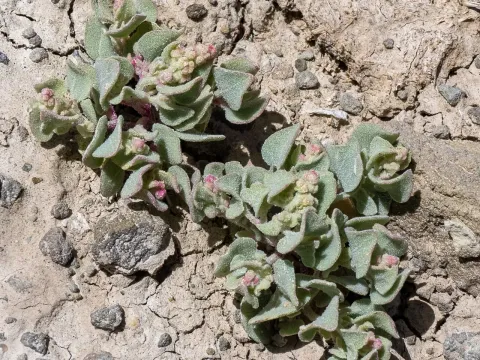
Atriplex saccaria
Atriplex saccaria
Atriplex saccaria, a member of the Amaranthaceae family, is an annual herbaceous plant noted for its remarkable ability to thrive in hostile environmental conditions.
What the section contains
Atriplex saccaria
This species is classified as a halophyte, meaning it is highly adapted to soils with high salt concentrations. It serves as an excellent candidate for reclaiming degraded lands where standard crops fail to establish.
Regarding soil requirements, it prefers well-drained, porous environments. It does not require high levels of nitrogen fertilization, as it can extract essential minerals efficiently from poor substrates.
Climatically, the plant favors arid and semi-arid regions. It exhibits high drought resistance, adjusting its physiological processes to minimize water loss during prolonged dry spells.
Agricultural management should focus on sufficient spacing during sowing to allow each individual plant to reach its full vegetative potential and maximize biomass production.
Atriplex saccaria possesses a robust defense system, making it inherently resistant to many common fungal and bacterial diseases that plague leafy vegetables and other field crops.
Potential threats include early-season insect pests such as leaf-eating beetles, which may impact the young foliage before the plant develops its protective cuticular wax.
Environmental stress, such as extreme waterlogging, can create favorable conditions for root-rot fungi, although this is rare in well-managed, naturally drained saline fields.
Integrated pest management strategies for this crop rely primarily on crop rotation and the maintenance of soil salinity levels that inhibit many generalist soil-borne pathogens.
Given its natural hardiness, the use of chemical pesticides is rarely required, which adds to the economic efficiency and environmental sustainability of the crop.