
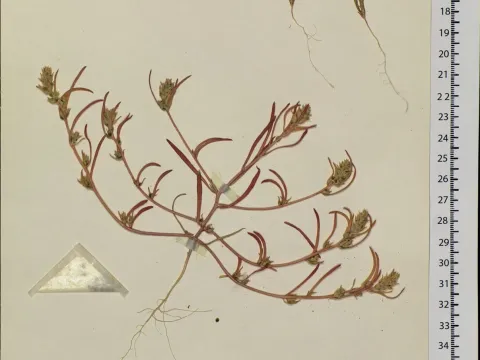
Staunton's combseed
Corispermum stauntonii
Sowing of Staunton's combseed (Corispermum stauntonii) is primarily carried out in the spring period when the soil warms up to 10–12 degrees Celsius. This plant is characterized by high seed germination energy, which allows for early sowing as soon as the danger of late frosts has passed.
What the section contains
Staunton's combseed
The optimal sowing method for this crop is the row method with row spacings from 15 to 30 centimeters. The seeding depth should be no more than 1–2 centimeters, given the small size of the seeds, ensuring uniform emergence even with moderate moisture in the topsoil horizon.
In regions with an arid climate, it is recommended to roll the soil immediately after sowing to improve seed-to-soil contact. This promotes more efficient use of soil moisture and prevents the seedbed from drying out in steppe and desert conditions.
The seeding rate is calculated based on the intended purpose of the crops: for green mass production, it can be increased, while for seed production, a lower plant density is maintained. The standard rate varies from 4 to 6 kilograms per hectare.
The plant has a high self-seeding capability under favorable conditions, so when growing it as an agricultural crop, one must consider the potential for field contamination in subsequent years if harvesting is delayed.
Staunton's combseed belongs to the Amaranthaceae family and is a typical xerophyte adapted to life under water-scarce conditions. It demonstrates phenomenal resistance to saline soils, including solonchaks and sandy soils, making it a promising crop for the restoration of degraded lands.
This crop is highly light-demanding and does not tolerate shading by other plants, so open, well-ventilated areas must be chosen for its cultivation. The plant is capable of enduring long periods of soil and atmospheric drought thanks to a powerful root system.
The crop is not demanding regarding the mechanical composition of the soil, but it shows the best growth performance on light sandy loam soils with good aeration. Excessive moisture and water stagnation are fatal for this crop as they promote the development of root rots.
During the vegetation process, the plant requires almost no additional mineral fertilization, as it has the ability to effectively extract nutrients from poor soils. However, moderate applications of nitrogen fertilizers during the early growth stages stimulate vegetative mass accumulation.
Climate requirements boil down to ensuring the sum of active temperatures necessary for the complete seed maturation cycle. The crop thrives in a continental climate with large diurnal temperature fluctuations, typical for arid zones.
The yield of green mass of Staunton's combseed depends on the level of agrotechnology and rainfall during the active growth period. On average, under favorable conditions, one can expect to obtain 10–15 tons of green mass per hectare.
The seed productivity of the crop is quite high, due to the large number of flowers formed on each shoot. With proper care, seed yields can reach 0.8–1.2 tons per hectare, making it economically viable for harvesting.
The economic use of the combseed includes its application as a forage resource for livestock (specifically camels and sheep) in areas with limited fodder bases. The green mass has satisfactory nutritional properties if harvested before the stems become coarse.
The seeds of this plant contain valuable fatty acids, which opens perspectives for using the plant as an oilseed crop in the future. Scientific studies confirm the presence of biologically active substances in the seeds, which are useful for the pharmaceutical industry.
Crop stability largely depends on the timeliness of harvesting, as plants can shatter if left too long in the field, leading to significant losses of the harvested product.
Staunton's combseed possesses a high level of natural immunity to most common agricultural diseases. Due to its biological nature, it is rarely affected by fungal diseases such as powdery mildew or rust.
The main threat to crops comes from soil pests, such as wireworms or mole crickets, which can damage seedlings in the initial growth stage. In cases of high pest populations, seed treatment with protective agents before sowing is recommended.
Harmful insects feeding on leaves rarely cause economically significant damage to the crop due to the presence of specific secondary metabolites that repel many pests. However, in years of mass locust outbreaks, partial damage to crops is possible.
Weed vegetation poses serious competition in the early stages of development. Since the initial growth of the crop can be slow, timely weed control in the row spaces is necessary until the leaves close up.
In waterlogged field conditions, root damage by bacterial rots is possible, so strict adherence to irrigation regimes and the selection of fields with good drainage are key elements of crop protection.
Harvesting Staunton's combseed for green mass is carried out in the budding phase when the plant contains the maximum amount of nutrients. Delaying the harvest time causes the stems to quickly become coarse, leading to a loss in feed value.
For seed production, harvesting is conducted during the period of full biological maturity, when the seeds acquire their characteristic color and separate easily from the perianth. It is very important to harvest on time to avoid mass seed shattering due to their high fragility.
Mechanized harvesting can be performed using grain combines with appropriate adjustments to the threshing apparatus clearances. Careful threshing allows for minimizing seed breakage and preserving germination capacity.
After harvesting, the seed material requires immediate cleaning from plant residues and drying to reach a moisture content of no more than 12–14 percent. This prevents self-heating and the development of mold fungi during long-term storage.
Seed storage is recommended in dry, cool rooms in bags or bins, ensuring protection from rodents. If all humidity and temperature conditions are met, the seeds maintain high sowing suitability for up to 2–3 years.