
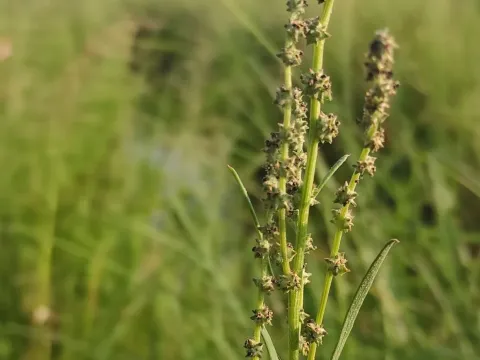
Spreading orache
Atriplex patens
Spreading orache is classified as an early spring annual, which begins to germinate once soil temperatures reach 3–5 degrees Celsius. Mass emergence usually occurs in late March or early April, depending on the climatic zone and local weather patterns.
What the section contains
Spreading orache
The seeds of this plant are known for their high viability, maintaining the ability to germinate in the soil for several years. Germination depth for naturally dispersed seeds ranges from 0.5 to 3 cm, allowing them to access necessary moisture and oxygen for early development.
In agroecosystems, this plant quickly occupies open niches, competing with commercial crops for light and space. Pre-seeding cultivation is an essential practice to reduce the density of emerging seedlings during the initial crop stages.
The plant exhibits a prolonged germination period, which is largely due to heterocarpy, the production of seeds varying in size and physiological activity. This survival strategy ensures the species' persistence even under unfavorable seasonal conditions.
Agricultural management should focus on stimulating early germination through soil disturbance and eliminating seedlings before they reach the reproductive growth phase.
This member of the Amaranthaceae family prefers well-lit environments with moderately moist and fertile soils. The plant demonstrates high ecological plasticity, allowing it to adapt to a wide variety of soil types, including those with higher salinity levels.
Spreading orache possesses good drought tolerance, although its most vigorous vegetative growth occurs when nitrogen levels and moisture availability are optimal. It thrives in a pH range from neutral to slightly alkaline.
With its robust root system, the plant effectively competes for nutrients, drawing resources from deeper soil horizons. Its C4 photosynthetic pathway allows for efficient carbon dioxide fixation even under high-temperature conditions.
Within agricultural fields, spreading orache often exploits gaps caused by poor agronomic practices or uneven crop seeding. A dense canopy of the main crop remains the most effective natural deterrent against the spread of this weed.
The temperate climate provides ideal conditions for the propagation of this species, and the absence of extreme limiting factors allows it to colonize significant areas of cultivated land.
Spreading orache often acts as a reservoir for various pests, which may subsequently migrate to vegetable and field crops. Notable examples include the beet fly and several species of aphids.
Infection with fungal pathogens, such as powdery mildew, is common, yet the weed rarely dies from these diseases due to its exceptional regenerative capacity. Instead, it serves as a significant inoculum source for neighboring crop plants.
Viral diseases transmitted by insect vectors often concentrate on the leaves of spreading orache, necessitating regular field monitoring. Broad-spectrum herbicide application is currently the standard method for controlling weed populations.
Mechanical damage to the main stem rarely kills the plant; instead, it often triggers active branching, making late-stage control significantly more difficult. It is critical to eradicate the plant before it sets viable seed.
Integrated Pest Management (IPM) strategies, including crop rotation and precision pesticide application, are recommended to minimize phytosanitary risks associated with the presence of this weed in agricultural plots.