
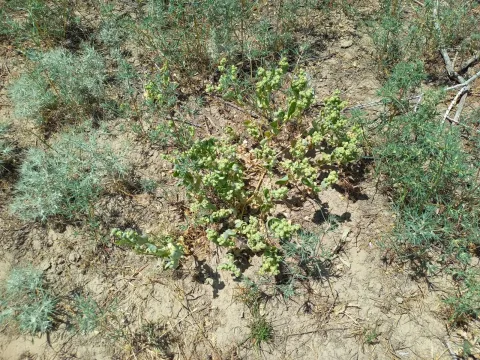
Central Asian saltbush
Atriplex centralasiatica
Central Asian saltbush (Atriplex centralasiatica) belongs to the Amaranthaceae family. Sowing is typically conducted in early spring once soil temperatures reach 10–12 degrees Celsius at a depth of 5–10 cm.
What the section contains
Central Asian saltbush
The seeds demonstrate high germination energy. Optimal sowing depth is shallow, ranging from 2 to 3 cm, to ensure successful emergence in well-prepared, moist seedbeds.
Standard row spacing for forage production is set between 30 and 45 cm, which facilitates mechanical weeding and promotes canopy development for maximum biomass accumulation.
Pre-sowing cultivation is essential to create a fine-textured soil surface, ensuring proper seed-to-soil contact which is crucial for uniform crop stand establishment.
Early sowing allows the crop to take advantage of spring moisture, helping it establish a robust root system before the onset of high summer temperatures.
As a notable halophyte, this species is exceptionally well-adapted to saline soils, often outperforming traditional crops in degraded or salty lands where productivity would otherwise be low.
The plant exhibits remarkable drought tolerance, making it an ideal choice for arid and semi-arid regions where water availability is the primary constraint for agricultural development.
It is a light-demanding crop that requires full sun exposure for optimal photosynthesis and nutrient accumulation; shade significantly impairs both growth rate and total yield.
Regarding soil, it is versatile and thrives in various textures, including sandy and loamy soils, provided they have adequate drainage and are not prone to prolonged waterlogging.
Good agronomic practice involves minimal intervention, primarily focused on early-stage weed control to ensure the crop establishes dominance in the field without competition.
Biomass yield potential can reach 20–30 tons per hectare under favorable conditions, particularly when supplemental irrigation is available during key vegetative stages.
The nutritional profile of the harvested forage is characterized by high protein and mineral content, which makes it a highly valuable supplement in livestock feed rations.
For seed production, yields typically range from 800 to 1,500 kg per hectare, depending on local climatic conditions and the intensity of the crop management strategy employed.
The plant's inherent resilience allows for stable production across diverse environmental conditions, providing a reliable safety net for farmers in marginal agricultural zones.
Management for multiple cuts is possible, allowing for several harvests per season if the growing conditions and irrigation management support continuous vegetative regrowth.
The crop is highly resistant to many common pests and diseases, which is attributed to the presence of secondary metabolites and specific phytochemical properties within its leaves.
Potential threats include occasional leaf-feeding beetles or weevils; however, these infestations are generally sporadic and rarely reach economic threshold levels requiring insecticide application.
Effective management against biotic threats relies on preventative measures such as crop rotation and the prompt removal of crop residues to disrupt pest life cycles.
Maintaining proper plant density is essential; overcrowding in high-humidity periods may lead to localized issues with fungal pathogens, though this is uncommon in arid cultivation sites.
Due to its natural robustness and typical usage as a forage crop, integrated pest management (IPM) practices focus on cultural methods rather than synthetic chemical intervention.
Harvesting for green forage should occur during the late vegetative stage or early budding, as this is when the biomass offers the highest nutritional quality and palatability.
For ensilage, the harvested material should be wilted to a target moisture content before chopping and compacting in storage structures to ensure optimal fermentation processes.
Seed harvesting must be timed with physiological maturity; the seeds should be firm and fully developed, with the husks showing a distinct color change and low moisture content.
Combining is the standard method for seed collection, using specialized settings to minimize mechanical damage and losses caused by seed shattering during the harvesting process.
Post-harvest conditioning includes cleaning the seeds using grain processing machinery to remove inert matter and ensure the high purity required for future planting or processing.