
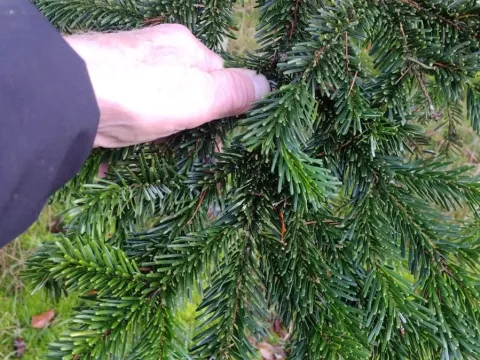
Fir
Abies Mill.
Sowing seeds of the genus Abies typically occurs in autumn or spring, following a stratification period of one to three months at low temperatures. To obtain high-quality nursery stock, seeds are sown into prepared seedbeds or containers filled with a lightweight, nutrient-rich substrate.
What the section contains
 Algerian fir
Abies numidica de Lannoy ex Carrière
Algerian fir
Abies numidica de Lannoy ex Carrière
 Balsam fir
Abies balsamea (L.) Mill.
Balsam fir
Abies balsamea (L.) Mill.
 California Red Fir
Abies magnifica A. Murray bis
California Red Fir
Abies magnifica A. Murray bis
 Cilician fir
Abies cilicica (Antoine & Kotschy) Carrière
Cilician fir
Abies cilicica (Antoine & Kotschy) Carrière
 Fraser fir
Abies fraseri (Pursh) Poir.
Fraser fir
Abies fraseri (Pursh) Poir.
 Grand fir
Abies grandis (Douglas ex D. Don) Lindl.
Grand fir
Abies grandis (Douglas ex D. Don) Lindl.
 Greek fir
Abies cephalonica Loudon
Greek fir
Abies cephalonica Loudon
 Korean fir
Abies koreana E. H. Wilson
Korean fir
Abies koreana E. H. Wilson
 Momi fir
Abies firma Siebold & Zucc.
Momi fir
Abies firma Siebold & Zucc.
 Nikko fir
Abies homolepis Siebold & Zucc.
Nikko fir
Abies homolepis Siebold & Zucc.
 Noble fir
Abies procera Rehder
Noble fir
Abies procera Rehder
 Nordmann fir
Abies nordmanniana (Steven) Spach
Nordmann fir
Abies nordmanniana (Steven) Spach
 Pacific silver fir
Abies amabilis Douglas ex J. Forbes
Pacific silver fir
Abies amabilis Douglas ex J. Forbes
 Sakhalin fir
Abies sachalinensis (F. Schmidt) Mast.
Sakhalin fir
Abies sachalinensis (F. Schmidt) Mast.
 Semenov fir
Abies sibirica Ledeb. subsp. semenovii (B. Fedtsch.) Farjon
Siberian fir
Abies sibirica Ledeb.
Semenov fir
Abies sibirica Ledeb. subsp. semenovii (B. Fedtsch.) Farjon
Siberian fir
Abies sibirica Ledeb.
 Sicilian fir
Abies nebrodensis (Lojac.) Mattei
Sicilian fir
Abies nebrodensis (Lojac.) Mattei
 Silver fir
Abies alba Mill.
Silver fir
Abies alba Mill.
 Spanish fir
Abies pinsapo Boiss.
Spanish fir
Abies pinsapo Boiss.
 Subalpine fir
Abies lasiocarpa (Hook.) Nutt.
Subalpine fir
Abies lasiocarpa (Hook.) Nutt.
 Trojan fir
Abies nordmanniana (Steven) Spach subsp. equi-trojani (Asch. & Sint. ex Boiss.) Coode & Cullen
Trojan fir
Abies nordmanniana (Steven) Spach subsp. equi-trojani (Asch. & Sint. ex Boiss.) Coode & Cullen
 Veitch's silver fir
Abies veitchii Lindl.
Veitch's silver fir
Abies veitchii Lindl.
 White fir
Abies concolor (Gordon & Glend.) Lindl. ex F. H. Hildebr.
White fir
Abies concolor (Gordon & Glend.) Lindl. ex F. H. Hildebr.
Fir
In industrial nurseries, the container-grown method is preferred as it ensures the development of a strong root system, which significantly improves the survival rate of seedlings during transplanting. The sowing depth is generally kept at 1–2 centimeters, followed by mulching the surface to prevent moisture loss.
Maintaining optimal stand density is a crucial management practice, as young firs are sensitive to light competition. The ideal time for establishing new plantations is at the start of the vegetative season, once the soil has warmed sufficiently and the risk of severe night frosts has passed.
Beyond seed propagation, grafting is actively used in breeding programs to preserve the distinct characteristics of specific varieties. Cuttings are utilized less frequently because many Abies species exhibit relatively low natural rooting percentages without the aid of growth stimulants.
After mass emergence, seedlings must be protected from direct intense sunlight and waterlogging, which can cause damping-off. Regular thinning is required to promote the development of a robust root system and a straight, healthy stem.
The fir tree, a member of the Pinaceae family, is a highly valuable forestry and ornamental crop known for its shade tolerance in early life. It thrives best in deep, fertile, and moderately moist soils that provide excellent drainage.
This crop is highly sensitive to air humidity and quality, struggling significantly in arid regions characterized by dry, hot winds. Fir trees prefer climates with moderate temperatures and consistent rainfall throughout the growing season.
The root system of most Abies species is taproot-oriented, penetrating deep into the soil and providing strong resistance against wind throw in mature trees. The crop is intolerant of saline or compacted soils, necessitating a thorough site assessment prior to large-scale planting.
Mineral nutrition management should be balanced; excessive nitrogen application can compromise winter hardiness and increase susceptibility to fungal pathogens. A balanced fertilizer blend specifically formulated for conifers is recommended to support steady growth.
Standard maintenance includes regular cultivation of the soil around young saplings and the monitoring of soil acidity. Keeping pH levels between 5.5 and 6.5 ensures optimal nutrient uptake and promotes a dense, vibrant needle canopy.
The economic utilization of fir is diverse, ranging from timber production for the pulp and paper industry to the extraction of essential oils and the sale of ornamental Christmas trees. Productivity is measured by biomass growth rates and the aesthetic quality of the crown.
For Christmas tree production, marketable size is typically achieved within 7 to 10 years of intensive management. Uniformity of the crown is essential and is achieved through annual shaping and pruning of the lower branches during the early growth stages.
Harvesting fir foliage for the pharmaceutical industry is a profitable venture, provided that plantations are managed for cyclic harvesting. Yields of green biomass are directly proportional to planting density and the quality of the agricultural practices employed.
Fir timber is valued for its lightness and lack of resin ducts, making it suitable for construction, packaging, and musical instrument components. However, it is less resistant to decay compared to spruce or pine, which dictates its specific industrial applications.
Maximum economic efficiency is realized through integrated production strategies that combine essential oil extraction with the sale of high-quality planting stock or decorative holiday trees from the same plantation.
The primary threats to fir plantations include fungal infections, such as fir needle cast, which can cause significant defoliation. Effective control strategies rely on the early removal of infected branches and the timely application of fungicides during peak infection periods.
Insect pests, including various species of loopers and aphids (Chermes), can severely damage the growth increment of young trees. Regular monitoring during the spring bud-burst period is essential to detect pest activity and apply necessary interventions.
Non-infectious physiological issues, such as needle scorch from direct sun or desiccation from winter winds, are common in the first few years of establishment. Providing shelterbelts or protective netting can mitigate these environmental risks significantly.
- Root rot caused by poor soil drainage and waterlogging.
- Rust diseases affecting the needles of lower tree tiers.
- Bark beetles that threaten the vitality of stressed stands.
An integrated pest management (IPM) approach, combining biological controls and responsible chemical use, is vital to ensure the long-term health of the plantation while minimizing the environmental impact.
Foliage harvesting for essential oil production is best conducted in winter or early spring when the concentration of volatile compounds in the needles and shoots is at its peak. Only current-year growth should be utilized to maintain tree vigor.
Thinning operations are conducted to improve stand quality, allowing the healthiest specimens to receive optimal light and nutrient access. The decision-making process for harvesting individual trees is based on health assessments and diameter measurements.
For ornamental purposes, trees are extracted with an intact root ball, requiring specialized machinery to ensure the integrity of the soil mass. This technique is critical for ensuring the successful transplanting and survival of the tree at its final location.
Collected foliage must be stored in cool, well-ventilated areas to prevent spontaneous heating and the loss of essential oil components. Processing should occur as rapidly as possible post-harvest to maintain the chemical quality of the product.
Site cleanup following harvest is essential to prevent the accumulation of debris, which can harbor insect pests and fungal pathogens. Proper land reclamation prepares the soil for subsequent planting cycles.