
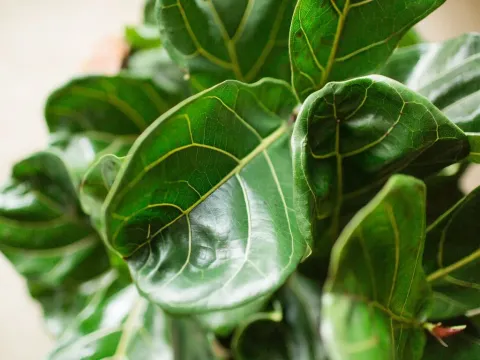
Fiddle-leaf fig
Ficus lyrata Warb.
The Fiddle-leaf fig (Ficus lyrata) is a prominent member of the Moraceae family. Native to the tropical rainforests of Western Africa, it has become a staple of the ornamental plant industry worldwide.
What the section contains
Fiddle-leaf fig
This crop requires bright, indirect light for optimal photosynthesis. While it can adapt to lower light levels, it thrives when provided with consistent, high-quality luminosity in a controlled environment.
Temperature management is critical for productivity. The plant performs best in a range of +20°C to +25°C, and it must be protected from cold drafts and sudden thermal fluctuations which cause leaf drop.
Soil structure should be well-draining, nutrient-rich, and slightly acidic. A mix consisting of peat, pine bark, and perlite ensures that the root zone receives adequate aeration while retaining necessary moisture.
Proper irrigation practices involve a cyclical approach where the substrate is allowed to dry out slightly before the next watering. Over-saturation of the root environment is the most common cause of crop failure.
Common pests include spider mites, scale insects, and mealybugs. These pests exploit dry indoor environments, often concentrating on the undersides of the broad leaves where they feed on sap.
Fungal issues such as leaf spot are frequently observed when humidity remains too high and air circulation is insufficient. These pathogens degrade the aesthetic value and overall health of the plant.
Root rot, driven by Phytophthora or Pythium species, occurs when drainage is obstructed. This disease inhibits nutrient uptake and can lead to rapid decline of the canopy.
Pest management relies on both biological controls and targeted chemical applications. Integrated pest management (IPM) is highly recommended to maintain plant vigor in a horticultural setting.
Regular sanitation of the leaf surface helps prevent dust accumulation, which improves the plant's ability to respire and reduces the likelihood of colonization by opportunistic pests.