
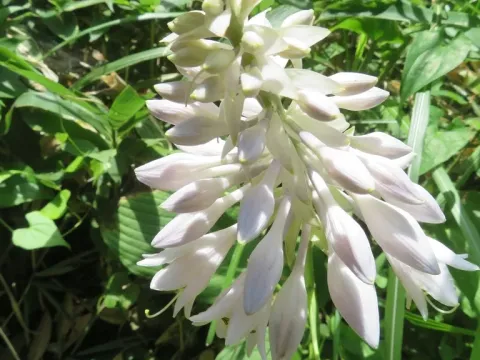
Hosta
Hosta Tratt.
Hosta (Hosta Tratt.), belonging to the Asparagaceae family, is a genus of shade-tolerant herbaceous perennials. Native to East Asia, including Japan, Korea, and China, these plants have become a staple in ornamental horticulture due to their architectural foliage and adaptability.
What the section contains
 Fortune's plantain lily
Hosta fortunei (Baker) L. H. Bailey
Fortune's plantain lily
Hosta fortunei (Baker) L. H. Bailey
 Hosta capitata
 (Koidz.) Nakai
Hosta capitata
Hosta capitata (Koidz.) Nakai
 Hosta clausa
 Nakai
Hosta clausa
Hosta clausa Nakai
 Hosta longipes
 (Franch. & Sav.) L. H. Bailey
Hosta longipes
Hosta longipes (Franch. & Sav.) L. H. Bailey
 Hosta minor
 (Baker) Nakai
Hosta minor
Hosta minor (Baker) Nakai
 Hosta plantaginea
 (Lam.) Asch.
Hosta plantaginea
Hosta plantaginea (Lam.) Asch.
 Hosta Tardiana
Hosta tardiana Hort.
Hosta Tardiana
Hosta tardiana Hort.
 Hosta yingeri
 S. B. Jones
Hosta yingeri
Hosta yingeri S. B. Jones
 Siebold's Hosta
Hosta sieboldiana (Hook.) Engl.
Siebold's Hosta
Hosta sieboldiana (Hook.) Engl.
 Wavy-leaf hosta
Hosta undulata (Otto & A. Dietr.) L. H. Bailey
Wavy-leaf hosta
Hosta undulata (Otto & A. Dietr.) L. H. Bailey
Hosta
The plant features a basal rosette of leaves that can range in size from tiny miniatures to massive specimens. The botanical structure is designed to thrive in forest understories, which is why hostas possess highly efficient leaf surfaces for photosynthesis under low-light conditions.
Cultivation requirements necessitate well-drained, humus-rich soil. Hostas perform best in environments with consistent moisture levels and a soil pH ranging from slightly acidic to neutral, which ensures optimal nutrient uptake throughout the active growing season.
Light management is a critical aspect of hosta agrotechnics. While some varieties tolerate morning sun, most benefit from dappled shade. Exposure to intense heat and direct sunlight leads to leaf scorching, especially in variegated cultivars that lack sufficient chlorophyll in certain leaf sections.
Hostas are renowned for their long-term stability in the landscape. They are vigorous growers that form dense clumps over time, effectively suppressing weed growth in the immediate vicinity and requiring minimal maintenance once established in the correct location.
Slugs and snails are the most significant pests for hostas, as they feed on the soft, succulent leaf tissue. Integrated pest management strategies, such as physical barriers or environmentally safe baits, are often required to maintain the aesthetic integrity of the plants.
Fungal diseases, including phyllosticta leaf spot and crown rot, can occur if there is inadequate air circulation around the plants. These issues are often exacerbated by excessive overhead irrigation or dense planting patterns that prevent rapid evaporation.
The Hosta Virus X (HVX) remains the most severe threat to plant health. This virus spreads through sap contamination, typically during division or pruning, causing mottled, crinkled, or necrotic patterns on the leaves, ultimately forcing the removal and destruction of the plant.
Foliar nematodes can also infest hostas, causing yellowing and browning between the leaf veins. This damage is often mistaken for fungal disease; however, it is distinguished by the specific linear pattern of the tissue necrosis following the veins.
Regular monitoring and good sanitation practices are essential. Tools should be sterilized between handling different specimens, and any plant material exhibiting symptoms of viral or significant fungal infections must be removed promptly to prevent spread to healthy stock.