
Siebold's Hosta
Hosta sieboldiana (Hook.) Engl.
Description
Growing requirements
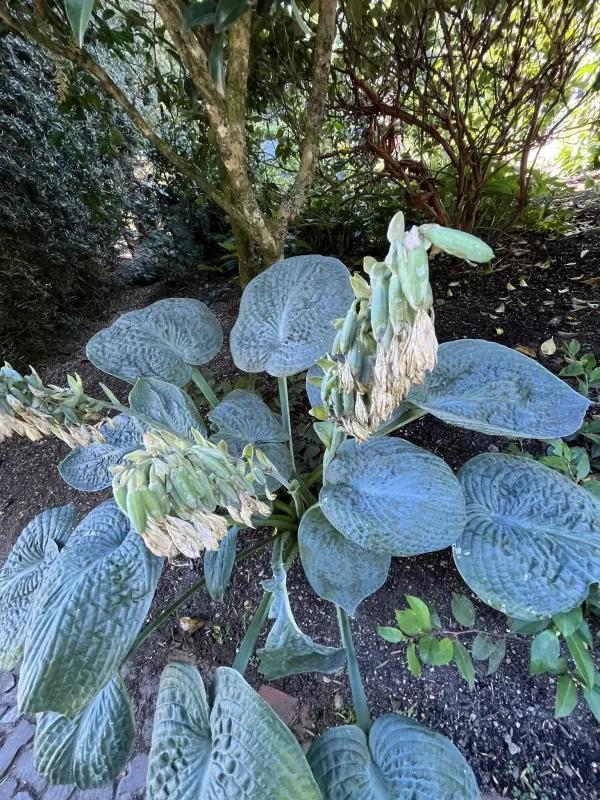
Siebold's Hosta (Hosta sieboldiana) is a perennial ornamental plant belonging to the Asparagaceae family. Native to Japan, this species is highly valued in horticulture for its massive, thick, blue-green leaves with prominent veining and heavy substance.
This species thrives in partially shaded environments. It requires moist, well-draining, and nutrient-rich soil. While it is quite adaptable, its best growth is observed in locations protected from intense afternoon sunlight which can scorch its large foliage.
Botanically, it forms dense clumps that expand over time. It is a slow-growing perennial, meaning that once established in a suitable spot, it can persist for decades with minimal maintenance. The plant also produces bell-shaped flowers on tall, sturdy stalks.
Temperature requirements are quite broad, as it is a hardy plant. It tolerates cold winters exceptionally well and is suitable for USDA hardiness zones 3 through 9. During summer, adequate watering is crucial to maintain the turgor of the leaves.
Cultural practices include spring fertilization with balanced NPK formulas to promote foliage vigor. Dividing mature clumps every 3 to 5 years is recommended to rejuvenate the plant and prevent it from becoming overly congested.
Main diseases and pests
Slugs and snails are the most significant pests for Hosta sieboldiana. They feed on the leaves, creating irregular holes that ruin the plant's appearance. Integrated pest management using bait or biological controls is often necessary in damp gardens.
Fungal diseases like Anthracnose or Botrytis can affect foliage, especially in conditions with high humidity and poor air circulation. Proper spacing between plants is the most effective preventative measure against these infections.
Hosta Virus X (HVX) remains a critical threat to the genus. Infected plants display mottled, distorted, or "ink-bleed" patterns on their foliage. There is no cure, and sterilization of gardening tools after contact with infected plants is mandatory.
Foliar nematodes cause brown, necrotic streaks that appear in late summer. Since these microscopic worms thrive in wet conditions, avoiding overhead irrigation is an essential practice for keeping the foliage dry and healthy.
Regular sanitation of the garden area is vital. Removing old, decaying leaves at the end of the growing season reduces the places where pathogens and overwintering pests can hide, ensuring a healthier start for the following spring.