
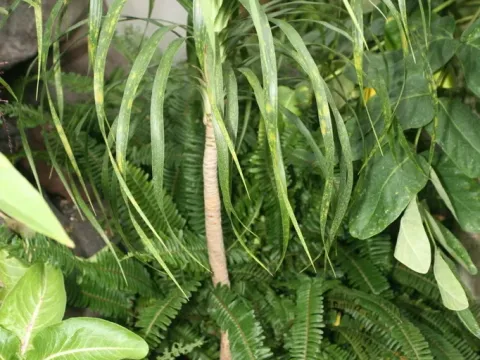
Dracaena
Dracaena Vand. ex L.
Dracaena (Dracaena Vand. ex L.) is a genus of monocotyledonous plants belonging to the family Asparagaceae. Native to tropical and subtropical regions of Africa, Southern Asia, and the Canary Islands, this culture has evolved to thrive in diverse microclimates, from shaded forest floors to arid landscapes.
What the section contains
 Dracaena concinna
 Kunth
Dracaena concinna
Dracaena concinna Kunth
 Dracaena elliptica
 Thunb.
Dracaena elliptica
Dracaena elliptica Thunb.
 Dracaena steudneri
 Schweinf. ex Engl.
Dracaena steudneri
Dracaena steudneri Schweinf. ex Engl.
 Dracaena surculosa
 Lindl.
Dracaena surculosa
Dracaena surculosa Lindl.
 Dragon tree
Dracaena draco (L.) L.
Dragon tree
Dracaena draco (L.) L.
 Fragrant dracaena
Dracaena fragrans (L.) Ker Gawl.
Fragrant dracaena
Dracaena fragrans (L.) Ker Gawl.
 Fragrant dracaena hybrid
Dracaena fragrans x Dracaena steudneri
Fragrant dracaena hybrid
Dracaena fragrans x Dracaena steudneri
 Gold Dust Dracaena
Dracaena surculosa Lindl. var. surculosa
Gold Dust Dracaena
Dracaena surculosa Lindl. var. surculosa
 Madagascar dragon tree
Dracaena marginata Lam.
Madagascar dragon tree
Dracaena marginata Lam.
 Song of India
Dracaena reflexa Lam.
Song of India
Dracaena reflexa Lam.
Dracaena
Environmental requirements for commercial or private cultivation include maintaining a steady temperature range of 20°C to 25°C. The plants are sensitive to cold drafts, which cause immediate leaf damage, and extreme heat, which can desiccate the foliage if humidity levels are not supplemented.
Soil and substrate management is critical for the long-term health of the root system. A well-draining, slightly acidic soil mixture is ideal, typically composed of peat moss, pine bark, and perlite. A heavy soil composition must be avoided to prevent root asphyxiation during irrigation cycles.
Irrigation practices should follow a wet-dry cycle, allowing the top 2-3 cm of the soil to dry before the next watering event. In high-density cultivation, automated monitoring of soil moisture content is recommended to ensure consistent crop development and prevent physiological disorders.
Light intensity requirements vary by species, though most commercial varieties perform best under bright, indirect light. Prolonged exposure to direct ultraviolet radiation can result in acute leaf burn, while insufficient light leads to stem etiolation and loss of vibrant leaf color.
Scale insects are a significant threat to Dracaena populations, often establishing themselves on stems and undersides of leaves. These pests are protected by a waxy cover, necessitating the use of systemic insecticides or targeted mechanical removal for effective control.
Spider mites (Tetranychidae) thrive in dry, stagnant air conditions. Infestations are characterized by fine webbing and yellow stippling on the leaves, which can lead to complete defoliation if left untreated for extended periods in a greenhouse setting.
Mealybugs represent another common pest, identifiable by their cotton-like appearance on leaf axils. They feed on plant sap and secrete honeydew, which serves as a substrate for sooty mold growth, further debilitating the plant’s health and reducing its aesthetic value.
Fungal pathogens such as Fusarium are frequently associated with over-irrigation. The symptoms, including leaf spotting and root decay, become severe when humidity is high and airflow within the canopy is insufficient, necessitating immediate fungicide treatment.
Root rot, primarily caused by Pythium and Phytophthora species, remains the most destructive disease in production facilities. Mitigation strategies must focus on strict sanitation, use of sterile potting media, and precise irrigation control to manage the pathogen environment.