


SKU #70002
·
57 views
IVANOVNA
Turnip
Гетерозисная селекцияUser rating
0 votes0% positive reviews
No ratings yet — be the first.
Root vegetable color
White
Meat
Juicy
Flavor
Semi-sweet
Root vegetable shape
Round
About product

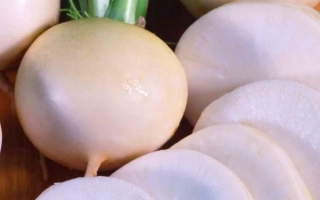
The rutabaga 'Ivanovna' variety is a mid-season, cold-hardy root crop that matures 76-78 days after germination. The plants do not form flower stalks, which eases care and contributes to increased yield. The roots have a round shape, smooth white skin, and snow-white, juicy flesh with a slight spicy sweetness. The average fruit weight is 250–300 grams. Thanks to its regular shape and attractive ap…
Root vegetable color
White
Meat
Juicy
Flavor
Semi-sweet
Root vegetable shape
Round
Description
The rutabaga 'Ivanovna' variety is a mid-season, cold-hardy root crop that matures 76-78 days after germination. The plants do not form flower stalks, which eases care and contributes to increased yield. The roots have a round shape, smooth white skin, and snow-white, juicy flesh with a slight spicy sweetness. The average fruit weight is 250–300 grams. Thanks to its regular shape and attractive appearance, the rutabaga 'Ivanovna' looks very aesthetic and is suitable for use fresh, as well as for preparing salads, stewed dishes, and casseroles.
This variety is distinguished by excellent taste qualities and high content of vitamins, proteins, carbohydrates, fiber, and antioxidants, which makes it a healthy and dietary product. Rutabaga 'Ivanovna' stores well in cool conditions for several months without losing taste and nutritional properties, allowing it to be used for both summer and winter consumption.
For successful cultivation, sowing is recommended in late April – early May for summer consumption and in early June for winter storage. Seeds are planted at a depth of 1–2 cm with a distance between rows of 20–30 cm. During growth, two thinning sessions, soil loosening, moderate watering (no more than 5 mm per day), and fertilization are carried out. It is important to maintain fertile, loose soil with good drainage capabilities and to monitor the condition of the plants to prevent diseases such as root rot and mealybug. Harvesting of roots is conducted selectively from early July to early September.
This variety is distinguished by excellent taste qualities and high content of vitamins, proteins, carbohydrates, fiber, and antioxidants, which makes it a healthy and dietary product. Rutabaga 'Ivanovna' stores well in cool conditions for several months without losing taste and nutritional properties, allowing it to be used for both summer and winter consumption.
For successful cultivation, sowing is recommended in late April – early May for summer consumption and in early June for winter storage. Seeds are planted at a depth of 1–2 cm with a distance between rows of 20–30 cm. During growth, two thinning sessions, soil loosening, moderate watering (no more than 5 mm per day), and fertilization are carried out. It is important to maintain fertile, loose soil with good drainage capabilities and to monitor the condition of the plants to prevent diseases such as root rot and mealybug. Harvesting of roots is conducted selectively from early July to early September.
Crop & resistance
Crop
Specifications
| Root vegetable color | |
|---|---|
| Meat | |
| Flavor | |
| Root vegetable shape | |
| Root vegetable mass, g | 250, 300 |
| Assignment | |
| Storage Duration (months) | 4 |
| Features | |
| Registration year | 2021 |
| Catalog | Catalog → Turnip |
| Manufacturer | Гетерозисная селекция |
| Legal data |
Show · 5
|
| Country | Russia |
Store offers
Prices are updated on loadLoading offers…
Aggregator catalog: prices are collected automatically from store websites, normalized by AI and converted at the current exchange rate. Before ordering, confirm the price and availability on the store's website. This block is not indexed by search engines — the data is loaded after the page opens.
Not yet комментариев. Be the first!







See also
Often considered together with this variety





Recently viewed
Products you’ve viewed on this site
Reviews · 0