
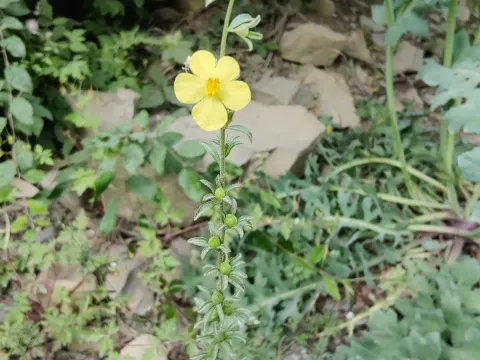
Oriental mullein
Verbascum orientale
Oriental mullein (lat. Verbascum orientale) belongs to the Scrophulariaceae family and is native to the regions of Southeastern Europe, Crimea, and the Caucasus. It is a hardy herbaceous plant typically found in open, rocky, or steppe habitats.
What the section contains
Oriental mullein
The botanical structure of the plant features pubescent foliage, which serves as a protective mechanism against evaporation and intense solar radiation. It typically grows as a biennial or a short-lived perennial with characteristic spikes of flowers.
The plant thrives in well-drained, sandy, or stony soils that mimic its natural wild environment. It is essential to avoid sites with heavy clay or poor drainage, as the roots are highly susceptible to rot under waterlogged conditions.
In terms of climate, Verbascum orientale is highly drought-tolerant and requires full sun exposure to flourish. It prefers dry, warm summers and can withstand significant temperature fluctuations, making it suitable for xeric landscaping.
Economically, it is primarily valued in ornamental horticulture for its architectural form and ability to grow in low-maintenance, dry garden beds or rockeries.
The plant is susceptible to various fungal diseases, particularly powdery mildew, which can develop during humid or stagnant air conditions.
Root rot caused by Oomycetes and other soil-borne pathogens is a significant threat if the soil remains excessively moist for long periods.
Aphids are the most common insect pests that infest the flower stalks, causing stunted growth and physical distortion of the flowering parts.
Caterpillars and other foliage-chewing insects can occasionally cause aesthetic damage to the leaves, though rarely causing plant mortality.
To mitigate these threats, it is crucial to ensure proper air circulation and avoid over-irrigation, prioritizing a dry-soil management strategy.