
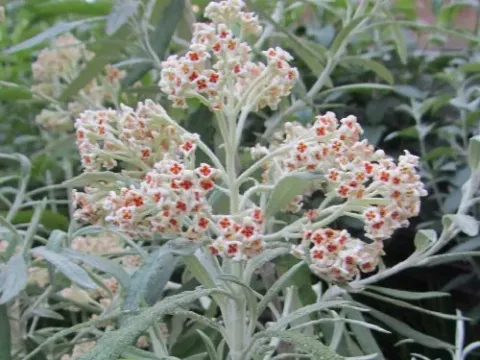
White Buddleja
Buddleja candida
Buddleja candida, commonly known as White Buddleja, belongs to the Scrophulariaceae family. It is a perennial deciduous shrub recognized for its unique foliage covered with fine white hairs, giving the plant a distinctive silvery appearance.
What the section contains
White Buddleja
The origin of this species is traced to the mountainous regions of Asia, specifically the Himalayas and parts of China. Due to its origin, the plant thrives in well-lit areas where it can receive direct sunlight for the majority of the day.
Regarding soil conditions, this culture requires fertile, well-draining soil with a neutral or slightly alkaline pH. It is highly intolerant of waterlogged conditions, which can lead to rapid root decay, making soil aeration a priority during site preparation.
The climate requirements for Buddleja candida involve moderate temperatures and protection from harsh frost. While it is hardy in many temperate zones, young plants require winter mulch and potential covering to prevent dieback of new shoots.
Commercially and ornamentally, the plant is widely utilized for landscaping and as an essential nectar source for pollinators, playing a significant role in supporting local biodiversity and butterfly populations.
Common agricultural threats for Buddleja candida include various fungal pathogens that flourish in stagnant air or excessively humid conditions. Monitoring for leaf spots and stem rot is critical for long-term survival.
Spider mites are a significant pest that can severely damage the foliage, particularly during hot and dry summer months. Their presence is usually detected by fine webbing and yellowing of the leaves.
Whiteflies can also cause substantial harm by colonizing the underside of leaves and draining the plant's resources. Integrated pest management, including the use of neem oil or targeted insecticides, is recommended.
To mitigate these threats, maintain adequate spacing between plants to ensure good airflow. Regular maintenance, including the removal of deadwood, significantly reduces the habitat available for pests and fungi.
- Annual pruning to encourage new growth and improve air circulation.
- Regular irrigation management to prevent root-zone saturation.
- Early intervention with acaricides upon the first sign of pest infestation.